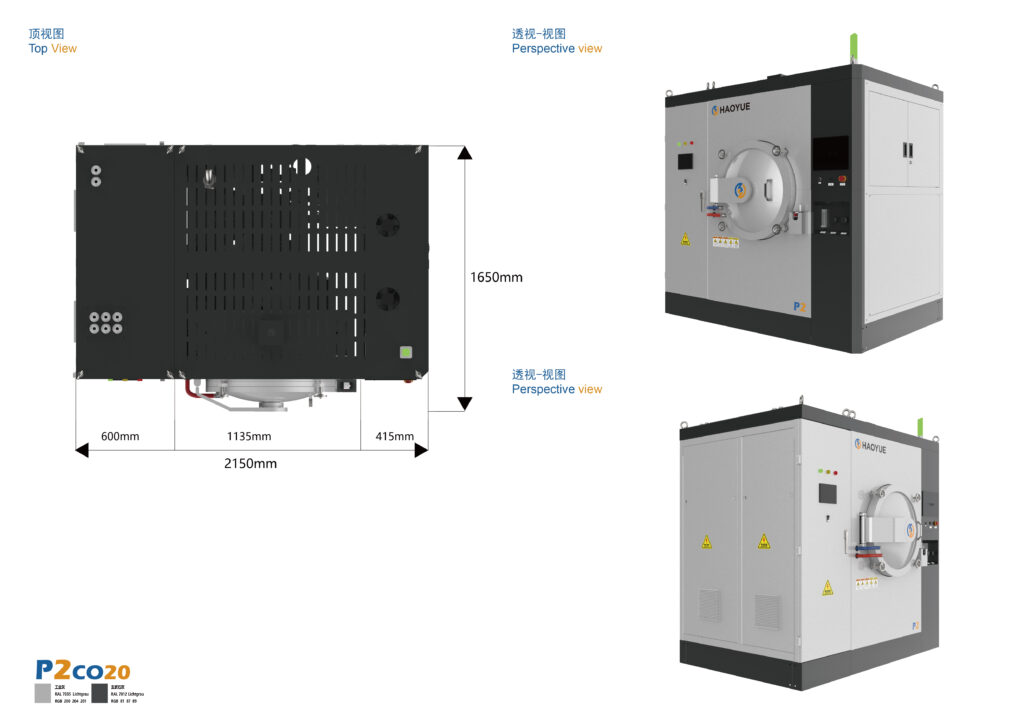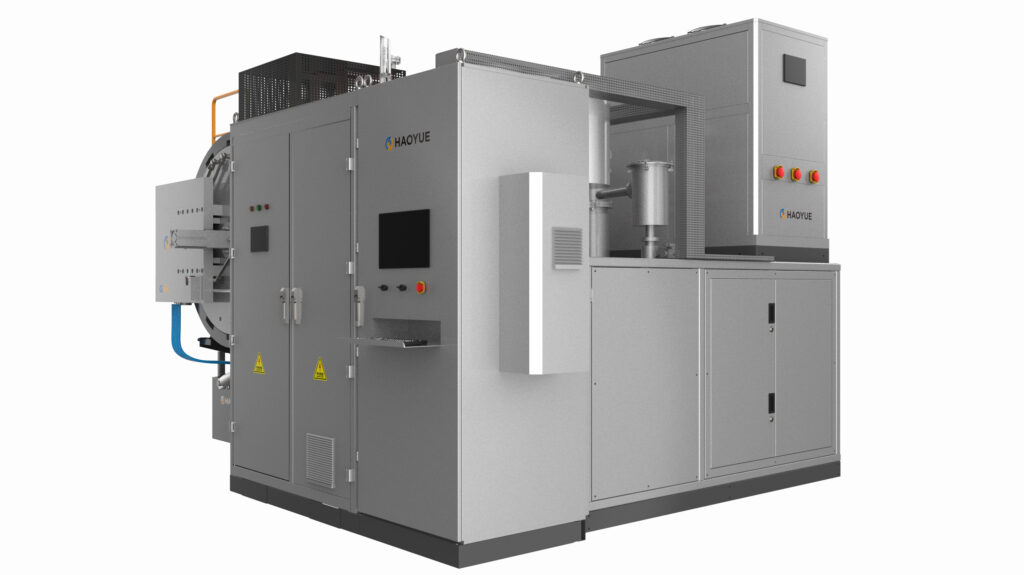

A tungsten vacuum furnace is a cold-wall vacuum furnace whose heating elements and radiation shields are made of tungsten instead of graphite, so the hot zone contributes no carbon to the load. A molybdenum vacuum furnace applies the same all-metal principle with molybdenum elements and shields — a lower temperature ceiling, a lower price, and far fewer surprises when the parts being processed are titanium, zirconium, or a samarium-cobalt magnet.
Most furnace conversations start with temperature. That is the wrong first question when the load is carbon-sensitive. The right first question is what the hot zone is made of, because above roughly 1000 °C a graphite hot zone is not an inert piece of furniture — it is a carbon source with a measurable vapour pressure of CO, CO₂ and hydrocarbons, and it is sitting centimetres away from your parts.

What a refractory-metal hot zone actually changes
Three things change when graphite is replaced by tungsten or molybdenum, and only one of them is about temperature.
The carbon source disappears. At sintering and annealing temperatures, carbon from felt, graphite heaters and graphite fixtures can be picked up by titanium, zirconium, hafnium, niobium, tantalum and their alloys, forming brittle carbides at grain boundaries. The same mechanism degrades nickel-base superalloys and shows up as a change in resistivity and wetting behaviour in sputtering targets. In an all-metal hot zone, the elements and shields are refractory metals; there is no carbon to pick up.
The insulation stops absorbing water. Graphite felt is hygroscopic. A felt pack that has been open to plant air will release moisture for hours after pump-down, and the residual gas analysis shows water and CO long after the gauge reads a respectable number. Metal radiation shields, by contrast, are sheet — they adsorb far less, and they can be baked clean.
The failure modes move elsewhere. You no longer worry about felt contamination; you now worry about oxygen, about element brittleness, and about the fact that a dented shield pack loses more performance than a scorched felt pack ever would. That trade is the subject of the rest of this page.
How a tungsten or molybdenum hot zone works
Stage 1 — Chamber and pumping
Both platforms are cold-wall, water-jacketed chambers. The high-vacuum figure quoted for these furnaces — 6.7×10⁻³ Pa — is a pump-package rating, not a property of the chamber alone: it requires a diffusion pump or a turbomolecular pump backed by a mechanical pump. A mechanical pump on its own reaches the rough-vacuum range (1 Pa class) and is not sufficient for refractory-metal processing, where residual oxygen is the dominant risk.
Leak rate and load outgassing decide whether you see that number: a clean, dry, lightly loaded chamber reaches it; the same chamber with a wet load and a marginal flange seal does not.
Stage 2 — The shield pack
Instead of felt, the hot zone is wrapped in multiple layers of molybdenum or tungsten sheet, typically 0.2–0.5 mm thick, separated by small gaps. Each layer reflects radiation back toward the load; the outermost layer stays close to water-jacket temperature.
Two consequences follow. First, shielding is only as good as its geometry — a warped or contaminated shield layer, or one that has been shorted against a heater, will show up as a hot spot on the outer wall and as a power bill that creeps upward run after run. Second, an all-metal pack has a higher heat loss than a thick felt pack, so the same chamber volume generally draws more power to hold temperature. That is the price of cleanliness, and it is worth stating plainly in any total-cost comparison.
Stage 3 — Elements and power delivery
Tungsten elements are supplied as rod, sheet or mesh, supported on insulated posts with generous clearance from the shields. Because tungsten and molybdenum are refractory metals with low resistivity compared with graphite, the power supply is characteristically low-voltage, high-current, fed through water-cooled copper busbars and a step-down transformer.
Element life is governed by three things: recrystallisation (which makes the metal brittle), oxygen attack, and mechanical contact with the load or the shields. A tungsten element that has run hot for months will not bend — it will crack. Handling procedures matter as much as the power supply design.
Stage 4 — Atmosphere and oxygen control
This is the stage where most field failures originate. Tungsten and molybdenum are protected by vacuum or by a dry reducing atmosphere, and they are attacked by oxygen and water vapour. Above roughly 700–1000 °C (typical for these oxides), molybdenum and tungsten form volatile oxides that leave the surface rather than protecting it; the result is a thinning element, a contaminated load, and a vacuum gauge that never quite recovers.
Practical rules we apply: no air or oxygen-bearing process gas in these hot zones; dew point monitored, not assumed, when hydrogen is used; a leak-up test on every campaign that follows a door opening; and a load chemistry review whenever a customer proposes a material that releases oxygen or water at temperature.
Stage 5 — Thermal profile and cooling
The published ramp window is 1–15 °C/min below 1600 °C and 1–10 °C/min above 1600 °C for the tungsten platform; the molybdenum platform runs 1–15 °C/min up to its 1300 °C ceiling. The reduction above 1600 °C is not conservatism for its own sake — thermal shock is what kills refractory metal elements and shields, and the load’s own thermal gradient usually sets the real limit before the furnace does.
Temperature uniformity is quoted as ±5 °C, measured at five points at 1000 °C after a one-hour hold. Multi-zone control, an industrial PC with PLC and PID loops, and an optional 2 bar gas fast-cooling circuit complete the picture.
Key parameters
| Parameter | Graphite hot zone (GR) | Tungsten hot zone (W) | Molybdenum hot zone (MO) |
|---|---|---|---|
| Listed maximum temperature | 2000/2400 °C | 1800/2000 °C | 1000/1300 °C |
| Vacuum (pump-package dependent) | 6.7×10⁻³ Pa | 6.7×10⁻³ Pa | 6.7×10⁻³ Pa |
| Ramp rate | 1–15 °C/min (<1600); 1–10 °C/min (>1600) | 1–15 °C/min (<1600); 1–10 °C/min (>1600) | 1–15 °C/min (<1300) |
| Carbon source in hot zone | Yes — felt, heaters, fixtures | None | None |
| Moisture retention | High (hygroscopic felt) | Low | Low |
| Oxygen tolerance | Moderate | Low | Low |
| Relative power draw | Lower | Higher | Higher |
| Mechanical robustness | High | Low (brittle when recrystallised) | Low–moderate |
| Relative consumable cost | Low | High | Moderate |
| Typical replacement interval | Long | Shorter, oxygen-dependent | Moderate |
Reading this table, the honest summary is: you do not buy a tungsten or molybdenum hot zone for temperature. You buy it because your material cannot tolerate carbon, or because you need a clean, fast-pumping, low-outgassing chamber for a process that runs below 2000 °C.
Models in our range
Tungsten hot zone — V series W
| Model | Chamber (mm) | Max temperature | Ultimate vacuum | Ramp |
|---|---|---|---|---|
| V3W20 | 300×300×400 | 1800/2000 °C | 6.7×10⁻³ Pa | 1–15 (<1600) / 1–10 (>1600) °C/min |
| V4W20 | 400×400×600 | 1800/2000 °C | 6.7×10⁻³ Pa | same |
| V5W20 | 500×500×700 | 1800/2000 °C | 6.7×10⁻³ Pa | same |
| V6W20 | 600×600×900 | 1800/2000 °C | 6.7×10⁻³ Pa | same |
All four share five-point ±5 °C uniformity at 1000 °C, multi-zone PID control and an optional 2 bar fast-cooling circuit.
Molybdenum hot zone — V series MO
| Model | Chamber (mm) | Max temperature | Ultimate vacuum | Ramp |
|---|---|---|---|---|
| V4M013 | 400×400×600 | 1000/1300 °C | 6.7×10⁻³ Pa | 1–15 °C/min (<1300) |
| V6M013 | 600×600×900 | 1000/1300 °C | 6.7×10⁻³ Pa | same |
| V7M013 | 700×700×1000 | 1000/1300 °C | 6.7×10⁻³ Pa | same |
| V8M013 | 800×800×1200 | 1000/1300 °C | 6.7×10⁻³ Pa | same |
| V10M013 | 1000×1000×1400 | 1000/1300 °C | 6.7×10⁻³ Pa | same |
Tungsten vs molybdenum vs graphite vs induction
| Criterion | Graphite (GR) | Tungsten (W) | Molybdenum (MO) | Induction graphite (CO) |
|---|---|---|---|---|
| Temperature ceiling | Highest | High | Moderate | High |
| Carbon pickup risk | Present | Absent | Absent | Present |
| Oxygen sensitivity | Lower | High | High | Lower |
| Ramp capability | Standard | Standard | Standard | Fast |
| Vacuum class | High vacuum | High vacuum | High vacuum | Rough/medium (5 Pa) |
| Best fit | C/C, graphite products, carbide, ceramics at high temperature | Refractory metals, titanium, carbon-sensitive ceramics | Bright annealing, magnetic materials, seals, hydrogen service | Large graphite loads needing fast cycles |
| Weakest point | Carbon and moisture | Cost, brittleness, oxygen | Ceiling, oxygen | Carbon, lower vacuum |
The choice between tungsten and molybdenum is rarely about which metal is “better”. It is a temperature decision inside a carbon-free constraint: molybdenum covers most annealing, brazing-adjacent and magnetic-material work up to 1300 °C at a lower consumable cost, while tungsten is the platform that keeps the carbon-free promise up to 2000 °C.
Applications
Refractory metals and their alloys. Tungsten, molybdenum, tantalum and niobium, including heavy alloys used for radiation shielding and counterweights, are sintered or annealed in these hot zones. Running them in graphite is technically possible and chemically undesirable: the very material being processed is also the material that most readily forms carbides.
Titanium and zirconium parts. Medical implants, aerospace brackets and chemical-process hardware with a specified interstitial content. Carbon pickup shows up as hardness and ductility drift long before it shows visually; the all-metal hot zone removes one variable from the metallurgy.
Samarium-cobalt magnets and magnetic materials. SmCo is sensitive to both carbon and oxygen; molybdenum hot zones are the practical home for this work, together with hydrogen-assisted processing where the dew point is controlled.
Technical ceramics with carbon sensitivity. Silicon carbide, silicon nitride and aluminium nitride parts that cannot accept a carbon-bearing atmosphere run on the tungsten platform. For pressure-assisted densification of the same materials, the route changes — a gas pressure sintering furnace at 6/10 MPa is the pressure answer, and the hot zone question becomes secondary.
Bright annealing and hydrogen service. Stainless steel, tool steel, high-speed steel, superalloys and non-ferrous strip run clean in molybdenum hot zones, with vacuum or hydrogen. Our H series vacuum hydrogen furnace uses molybdenum heating elements at 1000/1300 °C for exactly this family of work, including metallising, brazing and glass-to-metal sealing.
Sputtering targets and electronic materials. High-purity metals and alloys where a trace carbon background changes the film. This is a cleanliness specification more than a temperature one, and it is the clearest case where the higher power draw of an all-metal hot zone is simply accepted.
Limitations — when not to choose this
When you need more than 2000 °C. Tungsten does not compete with graphite at the top of the range. C/C composites, graphite electrodes, carbon felt and high-temperature carbide sintering belong in a graphite hot zone at 2400 °C.
When the load releases oxygen or water at temperature. Some oxide systems, binders and hydrated compounds evolve oxygen or moisture during heating. In a tungsten or molybdenum hot zone this attacks the elements directly. We would rather move that process to a graphite platform than sell a hot zone that will fail in six months.
When the process needs mechanical pressure. These are pressureless platforms. Hot pressing at 2200 °C with 100–1200 t of force is a different machine; so is gas pressure sintering at 6/10 MPa, and so is hot isostatic pressing at 100/150/200 MPa.
When the parts are large and cheap. A 1000 mm-class molybdenum chamber exists in our range, but for high-volume, cost-driven parts that tolerate carbon, graphite felt is cheaper to buy, cheaper to run and far more forgiving to load.
When nobody can be trained on handling. Tungsten elements and thin molybdenum shields are damaged by careless loading. If the shop cannot guarantee clearance discipline, the maintenance cost will erase the metallurgical benefit.
Related equipment
For pressureless high-vacuum work in graphite, tungsten or molybdenum hot zones, our vacuum sintering furnace range covers chamber sizes from 300×300×400 mm upward. When the process also needs a uniaxial load, the P-series graphite vacuum hot pressing furnace adds 100–1200 t of force up to 2200 °C, and for small refractory samples that must stay below the grain-coarsening window, the S2 spark plasma sintering system ramps up to 300 °C/min.
FAQ
What is the difference between a tungsten vacuum furnace and a molybdenum vacuum furnace?
The difference is the temperature ceiling and the consumable cost. Tungsten hot zones are listed at 1800/2000 °C and are used where the highest carbon-free temperature is required; molybdenum hot zones are listed at 1000/1300 °C, cost less to rebuild, and cover most annealing, magnetic-material and sealing work. Both are all-metal, cold-wall, high-vacuum designs at 6.7×10⁻³ Pa.
Will a tungsten hot zone eliminate carbon pickup completely?
It removes the hot zone as a carbon source. It does not remove carbon from the load, the binder, the fixtures you put inside, or the residual hydrocarbons in an unbaked chamber. The result is that carbon becomes a controlled variable rather than a background one — which is what most specifications actually need.
Why do these furnaces need a diffusion or molecular pump?
Because 6.7×10⁻³ Pa is a high-vacuum class, and a mechanical pump alone reaches only the rough-vacuum range. The pump package is selected per application: a lightly loaded, clean process may hold the number comfortably, while a load with high outgassing may need more pumping speed than the chamber volume alone would suggest.
Can I run hydrogen in a tungsten or molybdenum hot zone?
Hydrogen is used in these furnaces, but dew point must be controlled and monitored, because moisture attacks both metals at temperature. In our range the hydrogen-capable platform is the H series vacuum hydrogen furnace with molybdenum elements at 1000/1300 °C; for combined vacuum and hydrogen duty that is the configuration we normally quote.
My tungsten heater cracked after a few months. What usually causes that?
Three causes dominate: oxygen or water ingress through a small leak, mechanical contact between element and shield or load, and thermal shock from too steep a ramp or an uncontrolled cool-down. Recrystallised tungsten has almost no ductility, so a crack is a symptom — the root cause is usually in the atmosphere record or the loading procedure.
Can these furnaces sinter oxide ceramics?
Sometimes, and it needs a case review. Aluminium oxide and zirconia are routinely processed in graphite hot zones at higher temperatures; if the driver is carbon sensitivity rather than temperature, a molybdenum platform at up to 1300 °C can work provided the binder system does not evolve oxygen or moisture at temperature. Send us the material, binder and cycle and we will say plainly whether it fits.