What is a ceramic sintering furnace?
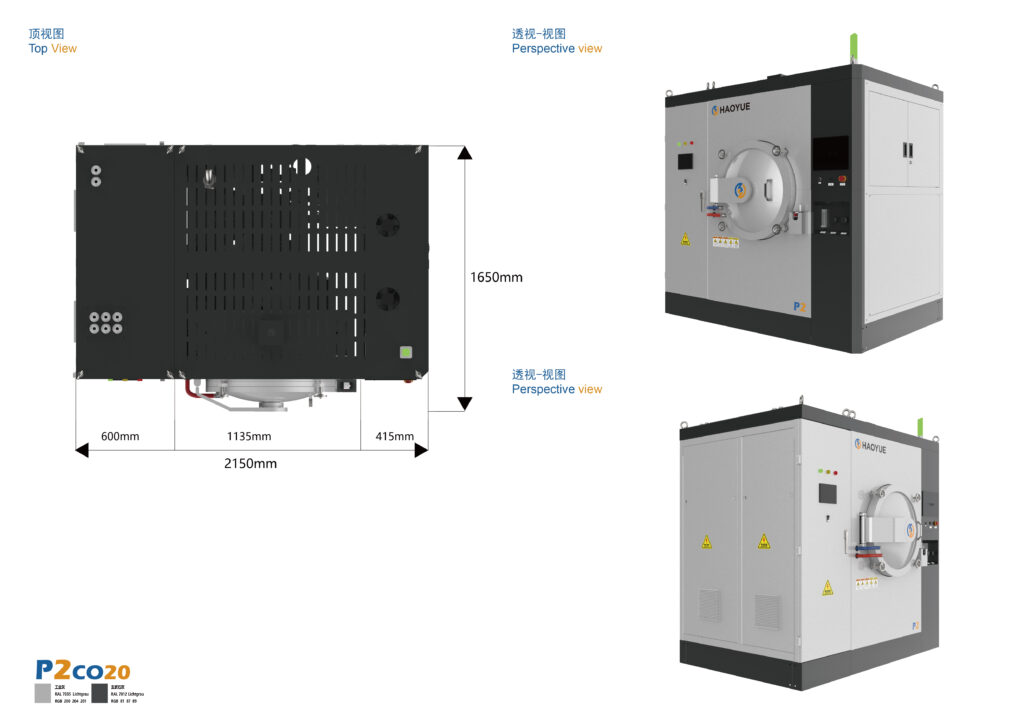
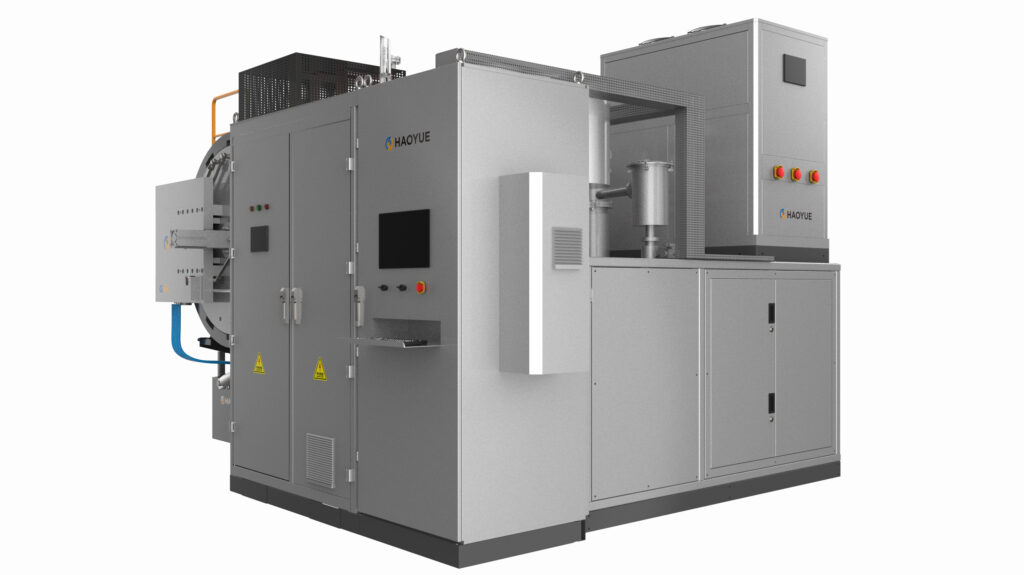
A ceramic sintering furnace is a controlled-atmosphere furnace that densifies a shaped ceramic compact below its melting point, converting a porous green body into a solid part through diffusion and, for most technical ceramics, a deliberately controlled furnace atmosphere.
The atmosphere is not an accessory bolted onto the thermal design. For an oxide ceramic such as Al₂O₃ the furnace atmosphere mainly protects purity and pulls trapped gas out of the pore network; for a covalent ceramic such as Si₃N₄ or SiC the atmosphere and an applied pressure are part of the densification mechanism itself, not a background condition.

How a ceramic sintering furnace works
A ceramic sintering furnace is a thermal system with a chemistry problem attached. Four process stages decide the outcome, and the first one happens long before peak temperature.
Stage 1 — Binder removal (debinding)
Green bodies arrive full of organic binder from pressing, injection moulding or tape casting. If that binder is not driven off before the pore network closes, it decomposes inside the part and shows up as blistering, internal cracks or carbon residue. The fix is a slow ramp and a dwell in the organic burn-out window — typically a few hundred degrees Celsius, well below the densification temperature — carried out under vacuum or a controlled atmosphere so the decomposition products leave the body rather than sit in it. Our V-series furnace is built as a vacuum debinding plus pressureless sintering platform, and our G-series integrates positive-pressure wax removal and vacuum wax removal into the same cycle as vacuum, partial-pressure and pressure sintering, so a wax-based body does not have to be moved between machines.
Stage 2 — Establishing the atmosphere
This is where the two ceramic families separate. Oxide ceramics — Al₂O₃, ZrO₂, MgO, mullite, TiO₂ — densify by solid-state or liquid-phase diffusion and need mainly a clean, low-oxygen environment; a high-vacuum configuration of 6.7×10⁻³ Pa with a diffusion or molecular pump is the standard route we supply for technical and transparent ceramics in the V-series. Non-oxide ceramics — Si₃N₄, SiC, AlN, B₄C, the borides — are covalent and have low self-diffusion coefficients, so vacuum alone is only the starting point: they are densified either with liquid-phase sintering additives under an inert-gas overpressure, or with an applied mechanical pressure.
Stage 3 — Heating into the densification window
The set-point follows the material, and the hot zone sets the ceiling. Graphite hot zones give the highest ceiling in our range at 2000 / 2400 °C; a tungsten hot zone at 1800 / 2000 °C is the carbon-free alternative for transparent and technical ceramics where carbon pick-up would be visible in the finished part; molybdenum covers the lower 1000 / 1300 °C band for metal-side and metallisation work.
Stage 4 — Dwell and grain control
Density is not the only target. In structural ceramics, grain size governs strength and toughness, so dwell time and ramp rate are used as microstructural tools rather than as logistics. Our V-series ramps at 1–15 °C/min below 1600 °C and 1–10 °C/min above 1600 °C. Pressure-assisted routes trade heating rate for grain-growth suppression: spark plasma sintering reaches up to 300 °C/min and therefore spends far less time in the grain-coarsening window.
Stage 5 — Controlled cooling
Cooling has to avoid both re-oxidation and thermal shock. An optional 2 bar gas rapid-cooling package circulates inert gas through the hot zone so the load comes down quickly; without it, cooling is radiative and can add hours to a cycle.
Key parameters to specify
| Parameter | Why it matters | Values in our furnaces |
|---|---|---|
| Max temperature | Selects the hot zone material, and with it the ceramic family you can run | 2000 / 2400 °C (graphite) · 1800 / 2000 °C (tungsten) · 1000 / 1300 °C (molybdenum) |
| Ultimate vacuum | Removes trapped gas and keeps grain boundaries clean | 6.7×10⁻³ Pa with a diffusion or molecular pump; 1 Pa for mechanical-pump-only configurations; 5 Pa and 10 Pa on induction and continuous platforms |
| Atmosphere | Decides whether a covalent ceramic can densify at all | Vacuum, partial-pressure inert gas, or 6 / 10 MPa nitrogen or argon overpressure (gas pressure sintering) |
| Applied pressure | Closes porosity that diffusion alone cannot | Uniaxial 100–1200 t (hot pressing); 50–400 kN (SPS); 6 / 10 MPa gas pressure (GPS) |
| Ramp rate | Controls grain growth and thermal shock | 1–15 °C/min below 1600 °C; 1–10 °C/min above; up to 300 °C/min with SPS |
| Temperature uniformity | Determines yield across a load | ±5 °C (five-point survey calibrated at 1000 °C) |
| Useful chamber size | Sets part envelope and batch weight | 300×300×400 mm up to 1000×1000×1400 mm |
One clarification that prevents a lot of mis-specification: the vacuum figure is a pump-set decision, not a furnace-quality score. A chamber ordered with mechanical pumping only reaches the rough-vacuum range around 1 Pa and is intended for duties that do not need high vacuum. If your process depends on oxide reduction or on degassing a fine ceramic powder compact, specify the high-vacuum configuration explicitly rather than assuming it comes as standard.
Which furnace for which ceramic family
Ceramics that share a name on a purchase order often need completely different furnaces.
| Ceramic family | Examples | Densification route | Furnace in our range |
|---|---|---|---|
| Oxide ceramics | Al₂O₃, ZrO₂, MgO, mullite, TiO₂ | Solid-state or liquid-phase diffusion; no applied pressure required | V-series, graphite hot zone |
| Transparent and technical ceramics | Al₂O₃, ZrO₂, SiC, Si₃N₄ requiring a carbon-free chamber | High vacuum, contamination-free sintering | V-series, tungsten hot zone (1800 / 2000 °C) |
| Covalent nitrides and carbides | Si₃N₄, SiC, AlN | Liquid-phase sintering under inert-gas overpressure, or pressure-assisted | G-series gas pressure sintering (6 / 10 MPa); P-series hot pressing; SPS |
| Borides and ultra-high-temperature ceramics | TiB₂, ZrB₂, HfB₂, B₄C | Applied pressure required to reach density | P-series hot pressing; SPS |
| Green-body debinding | all of the above | Vacuum or positive-pressure wax removal before sintering | V-series (vacuum debinding); G-series (integrated wax removal) |
| Metallised or brazed ceramic assemblies | Al₂O₃ metallisation, glass-to-metal seals | Reducing atmosphere at moderate temperature | H-series vacuum hydrogen furnace (1000 / 1300 °C) |
Alumina ceramic vacuum sintering: a worked example
Alumina is the most common technical ceramic and a good test case, because a single material name hides three different requirements — and therefore three different furnaces.
- Standard 96–99% alumina for wear parts, seals and electrical insulation. These densify well by pressureless vacuum sintering in a graphite hot zone. The furnace’s job here is temperature uniformity and a reliably clean atmosphere, not pressure.
- High-purity and transparent alumina, where both carbon pick-up and residual porosity reduce optical transmission. The answer is a carbon-free tungsten hot zone at 1800 / 2000 °C under high vacuum, not a graphite chamber that happens to be cheaper.
- Alumina that must approach full density without a pressure head — a shape that cannot take a uniaxial load, or a batch where tooling cost rules out hot pressing. Gas pressure sintering at 6 / 10 MPa sits between pressureless vacuum sintering and full hot pressing and covers Al₂O₃, ZrO₂, SiC and Si₃N₄ bodies.
If you are specifying an alumina ceramic vacuum sinter furnace, the practical question is therefore not “how hot?” but “which of these three alumina processes am I actually running?” The answer decides the hot zone material, the pump set and whether you need pressure at all.
Ceramic sintering furnace vs alternative processes
| Process | Temperature | Pressure / atmosphere | Best for ceramics when |
|---|---|---|---|
| Vacuum sintering furnace | up to 2000 / 2400 °C (graphite) | High vacuum 6.7×10⁻³ Pa, optional partial pressure | Oxide ceramics, debinding plus pressureless sintering, carbon-compatible bodies |
| Gas pressure sintering (GPS) | 1600 / 2000 °C | 6 / 10 MPa nitrogen or argon | Si₃N₄, SiC, ZrO₂, Al₂O₃ needing near-isostatic densification without a pressure head |
| Vacuum hot pressing | 2200 °C | Uniaxial, 100–1200 t | SiC, B₄C, BN and composites where pressure is the only route to full density |
| Spark plasma sintering (SPS) | 2200 °C | Uniaxial, up to 300 °C/min | Fine-grained ceramics where grain growth must be suppressed; R&D and pilot volumes |
| Hot isostatic pressing (HIP) | 1400 / 2000 °C | 100 / 150 / 200 MPa inert gas | Post-densification of ceramic bodies whose porosity is already closed |
| Vacuum hydrogen furnace | 1000 / 1300 °C | Vacuum plus hydrogen | Ceramic metallisation, brazing and glass-to-metal sealing |
For pressureless densification of oxide ceramics in high vacuum, our vacuum sintering furnace range covers graphite, tungsten and molybdenum hot zones in matched chamber sizes. For covalent ceramics that need an overpressure rather than a pressure head, the G-series horizontal gas pressure sintering furnace applies 6 / 10 MPa of inert gas. And where grain size rather than density is the limiting property, the S2 spark plasma sintering system delivers ramps up to 300 °C/min.
Applications
- Technical and wear ceramics — alumina seals, guides, thread guides and liners sintered in graphite hot zones.
- Transparent ceramics — optical and armour windows, laser host materials, where a carbon-free tungsten hot zone protects transmission.
- Cutting-tool ceramics — Si₃N₄, SiC, TiB₂ and SiAlON inserts that need pressure or an overpressure atmosphere to reach density.
- Electronic and semiconductor ceramics — AlN substrates and ZrO₂ electrolytes, sensitive to both contamination and residual porosity.
- Ultra-high-temperature ceramics — borides and carbides for aerospace and high-temperature structural use.
- Metalised and brazed ceramic assemblies — vacuum-tube, sensor and power-module packaging processed in a hydrogen atmosphere.
Limitations — when a ceramic sintering furnace is the wrong purchase
- Your body was never properly compacted. Sintering cannot repair a poor green body; if the part is already dense and the goal is closing closed porosity, HIP is the correct tool.
- You need a fully dense Si₃N₄ or SiC part. Vacuum alone will not do it. Covalent ceramics need liquid-phase additives plus inert-gas overpressure, or an applied pressure — a pressureless vacuum furnace is the wrong route regardless of how hot it goes.
- You only need binder removal. A dedicated debinding furnace, or the integrated wax-removal stage of a combined machine, is cheaper than a full high-vacuum sintering platform.
- Your material cannot touch carbon above 1800 °C. Then graphite is excluded and tungsten raises both capital cost and element replacement cost.
- You are running single small samples. SPS can be the faster and cheaper development route for samples from Φ80–120 mm up to Φ300–400 mm before you commit to a production furnace.
- Your requirement is metallisation or brazing, not bulk sintering. That is a 1000 / 1300 °C hydrogen-furnace job, not a 2400 °C vacuum chamber.
FAQ
What is a ceramic sintering furnace used for?
It densifies a shaped ceramic compact below its melting point, turning a porous green body into a solid part. In practice it also performs binder removal, and for covalent ceramics such as Si₃N₄ it provides the pressure or atmosphere that makes densification possible at all.
What is the difference between sintering alumina in vacuum and by gas pressure sintering?
Both can produce dense alumina. Vacuum sintering is the simpler, lower-cost route for standard 96–99% alumina in a graphite hot zone. Gas pressure sintering at 6 / 10 MPa is used when the shape cannot take a uniaxial load and the body has to approach full density without a pressure head.
Can Si₃N₄ and SiC be sintered in a vacuum furnace?
Not to full density on their own. These are covalent ceramics with low self-diffusion coefficients, so they are densified with liquid-phase sintering additives under inert-gas overpressure — 6 / 10 MPa in our G-series — or with applied pressure in a hot press or SPS system.
What vacuum level does ceramic sintering need?
It depends on the family. Technical and transparent ceramics benefit from high vacuum — 6.7×10⁻³ Pa with a diffusion or molecular pump — to remove trapped gas and keep grain boundaries clean. Mechanical pumping alone reaches only the rough-vacuum range around 1 Pa and is intended for duties that do not require high vacuum.
How fast can a ceramic sintering furnace ramp?
Our V-series ramps at 1–15 °C/min below 1600 °C and 1–10 °C/min above 1600 °C, with temperature uniformity mapped at ±5 °C using a five-point survey at 1000 °C. Pressure-assisted routes are much faster: SPS reaches up to 300 °C/min.
When should I choose hot pressing or SPS instead?
When density, not just heating, is the problem. Uniaxial hot pressing reaches 2200 °C with 100–1200 t of force for SiC, B₄C and BN bodies; SPS reaches the same 2200 °C with ramps up to 300 °C/min when fine grain size matters more than batch size.