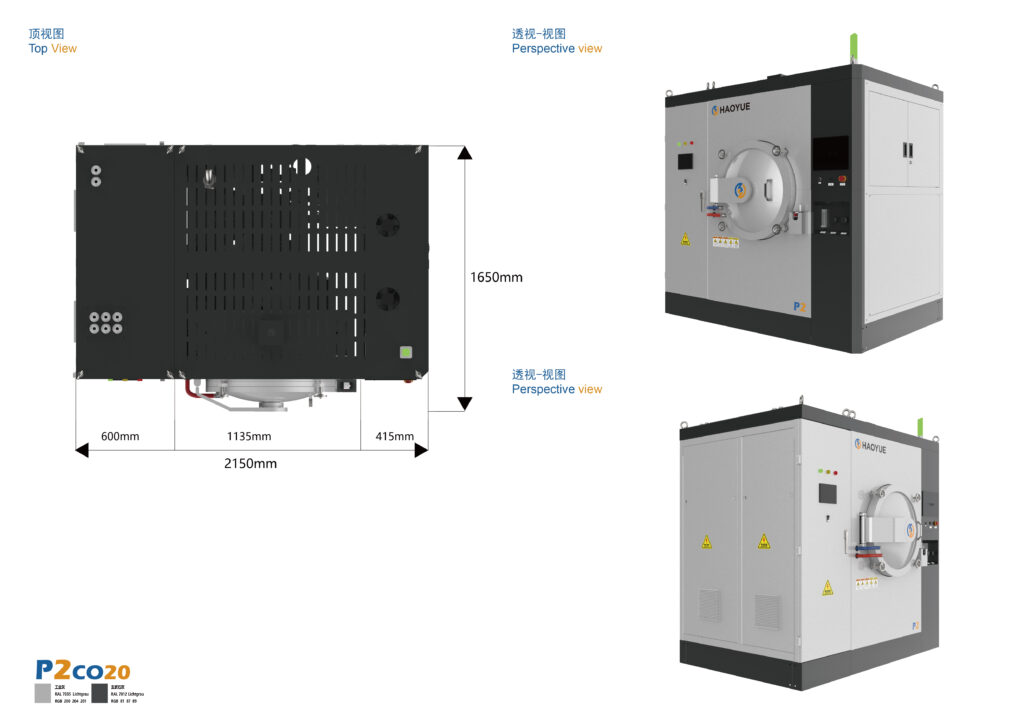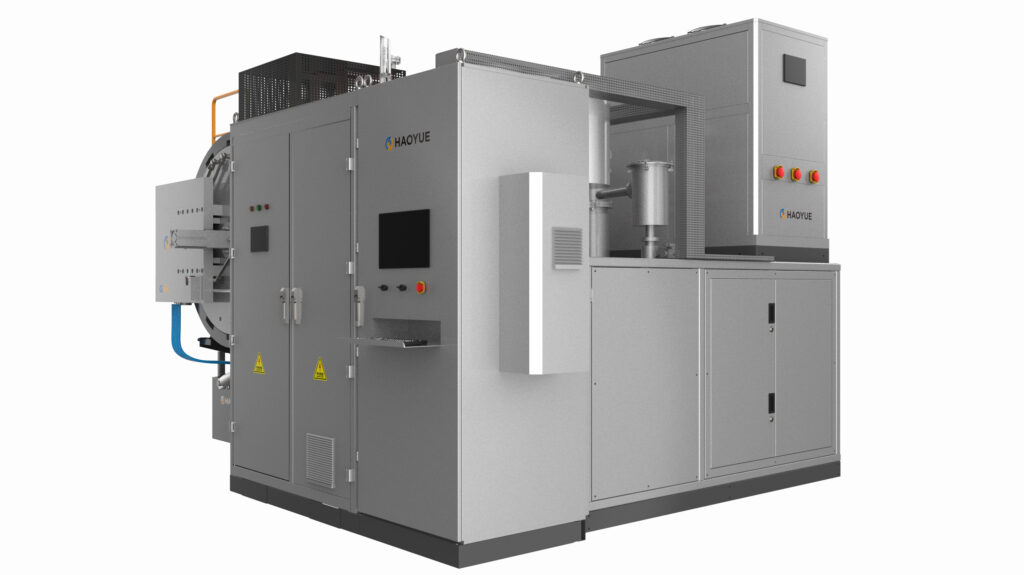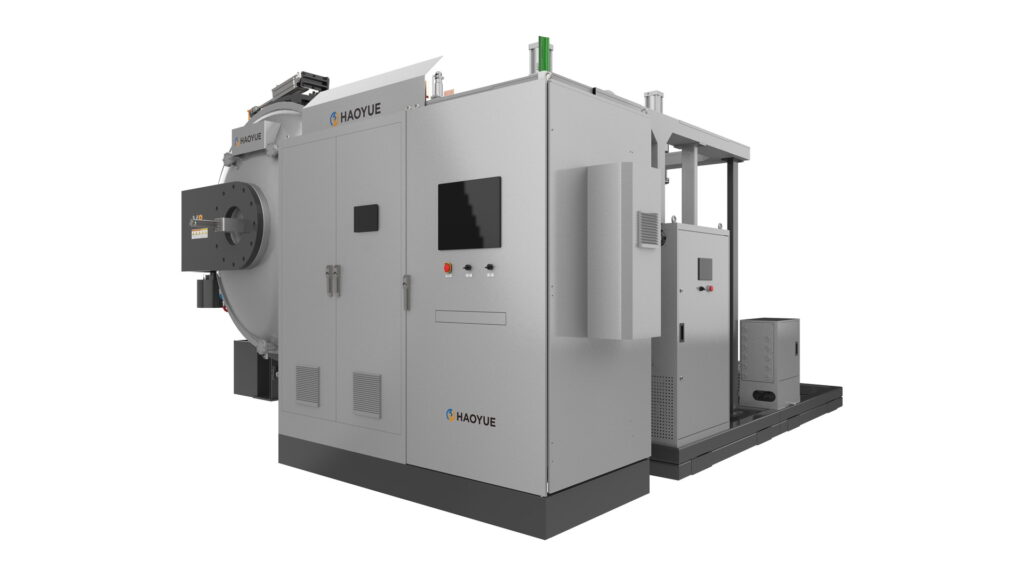
A high vacuum furnace is a vacuum vessel that reaches 6.7×10⁻³ Pa and holds it at process temperature, which means the pump stack — diffusion or turbomolecular, backed by a mechanical pump — and not the heating element sets the ceiling on what the load can become. The number on the data sheet is the easy part. Three things have to agree before a gauge reads it with a hot load inside: the pumps, the sealing boundary, and what the load and hot zone release once warm.
Most enquiries quote a pressure and a temperature in one sentence, as though they were independent specifications. They are not: a chamber that reaches 6.7×10⁻³ Pa empty and cold can sit at 6.7×10⁻² Pa for the whole soak with a wet load inside.

What the pressure number on the sheet does not tell you
A specification usually lists one pressure. There are at least three readings behind it.
Ultimate pressure is measured on an empty, clean, cold chamber after a long pump-down, gauge at the pump port. It describes the pump stack and the tightness of the vessel, and nothing about a process.
Working pressure is what the load sees during the hold. It is always higher, often by one or two decades in typical cycles, because outgassing rises steeply with temperature. This decides whether a refractory metal densifies or a braze flows.
Gas composition is the third, and the one buyers forget. 6.7×10⁻³ Pa of water vapour is not the same atmosphere as 6.7×10⁻³ Pa of nitrogen: at equal total pressure the oxygen partial pressure can differ by orders of magnitude, and that is what oxidises titanium, molybdenum or a nickel braze filler. It is also why the gauge position matters — a gauge at the pump port measures the pump, a tube in the hot zone measures the process.
How a high vacuum furnace gets there, stage by stage
Stage 1 — Roughing: the only stage that is about volume
A mechanical pump takes the chamber from atmosphere to the crossover point the high-vacuum pump will accept, typically in the 10 Pa decade. This is the only part of the cycle where volume dominates; afterwards, surface area and temperature rule — a large empty chamber pumps faster than a small one full of powder.
Stage 2 — Crossover and the high-vacuum stage
A diffusion pump needs its foreline below a tolerable backing pressure; a turbomolecular pump tolerates more but dislikes bursts of dust and condensables. Both need protection upstream, and at 6.7×10⁻³ Pa a cold trap or baffle does two jobs: it stops oil vapour backstreaming onto the load — a real contamination path in brazing and metallisation — and it holds water vapour that would otherwise load the pump.
Stage 3 — The heating hump
As the hot zone comes up, pressure rises even with the pumps running. Water leaves the insulation, binder residue leaves the load, and graphite releases what it adsorbed during the last shutdown. Operators watching only the cold reading diagnose a leak; nine times out of ten it is the load. Log the pressure-rise curve cold, repeat it hot, and the two curves tell you which.
Stage 4 — Working pressure is chosen, not suffered
Two legitimate responses to the hump: hold at the highest pressure the process tolerates by admitting clean argon or nitrogen, or open a controlled leak to sweep the vessel. Both are partial-pressure operation, and both convert a vacuum problem into a gas-purity problem. Partial pressure is also the answer when the alloy contains a volatile element — at 6.7×10⁻³ Pa above 1000 °C, chromium, manganese and zinc leave the surface rather than stay in the part.
Stage 5 — Cooling, backfill and re-adsorption
Cooling in high vacuum is radiant and slow. The optional 2 bar fast cool shortens it by putting gas back in the vessel; the trade is that the gas must be clean and dry, or the load is contaminated while it is still hot enough to react. Afterwards, graphite insulation keeps adsorbing moisture while the vessel sits open — which is why the first pump-down of the week is longer than the last of the previous one, and why a burn-off belongs in the schedule, not the emergency procedure.
Key parameters that decide whether 6.7×10⁻³ Pa is real
| Parameter | What it actually controls | What we specify |
|---|---|---|
| Ultimate pressure, empty and cold | Pump class, and whether the vessel is worth the pump | 6.7×10⁻³ Pa on diffusion or molecular pump sets; 6.7×10⁻² Pa on the P3 hot press; 1 Pa on mechanical-pump-only builds |
| Working pressure at temperature | What the load sees during the soak | Not a fixed figure — ultimate pressure plus whatever the load releases |
| Pumping speed against chamber volume | Pump-down time before the load is hot | Selected against chamber size and load surface area, not volume alone |
| Leak rate / pressure-rise rate | Whether the vessel holds when isolated | Agreed per project on an isolated, clean, empty chamber; a few pascal per hour is typical acceptance practice |
| Hot zone material | The outgassing source closest to the load | Graphite (GR), molybdenum (MO), tungsten (W), C/C |
| Gauge position | Whether the reading describes the pump or the process | Pump-port flange compared against a tube at the load |
Furnaces in our range built for high vacuum
| Series | Models | Chamber (mm) | Vacuum | Max temperature |
|---|---|---|---|---|
| V — graphite hot zone | V3GR24 to V8GR24 | 300×300×400 to 800×800×1200 | 6.7×10⁻³ Pa | 2000/2400 °C |
| V — tungsten hot zone | V3W20 to V6W20 | 300×300×400 to 600×600×900 | 6.7×10⁻³ Pa | 1800/2000 °C |
| V — molybdenum hot zone | V4M013 to V10M013 | 400×400×600 to 1000×1000×1400 | 6.7×10⁻³ Pa | 1000/1300 °C |
| D — diffusion bonding | D4M014, D9M014, D8M014, D10M014 | 400×400 to 1200×1000 | 6.7×10⁻³ Pa | 1400 °C |
| H — vacuum hydrogen | H4M013 to H8M013; HV6S/120, HV6S/320 | 400×400×600 to 800×800×1200; Ø650×1200, Ø650×3200 | 6.7×10⁻³ Pa | 1000/1300 °C |
| P — vacuum hot pressing | P5VGR22 to P11VGR22 | Ø500×700 to Ø1100×900 | 1 Pa or 6.7×10⁻³ Pa, pump option | 2200 °C |
Two notes on that table. The P5 to P11 hot presses list two vacuum configurations because the pump set is chosen at order, not because pressure varies in service; the base build is mechanical only at 1 Pa. And the H series is a vacuum-plus-hydrogen platform — hydrogen is admitted deliberately, and the safety case, not the pump, sets the envelope.
Heat-up rates are 1–15 °C/min below 1600 °C and 1–10 °C/min above it, with 1–15 °C/min to 1300 °C on the molybdenum and hydrogen platforms. Uniformity is ±5 °C by five-point survey at 1000 °C, held 1 h on box chambers and 2 h on hot presses. Neither depends on the vacuum class, which is why the vacuum class deserves its own decision.
High vacuum against the other four atmosphere strategies
| Route | Pressure band and pump set | What it removes | Wins when | Fails when |
|---|---|---|---|---|
| High vacuum | 6.7×10⁻³ Pa; mechanical plus diffusion or molecular | Residual gas and water, down to the lowest practical oxygen partial pressure | Refractory metals, brazing, metallisation, bright annealing | Volatile alloying elements; heavy binder load |
| Medium vacuum | 6.7×10⁻² Pa; mechanical plus smaller high-vacuum stage | Most of the atmosphere, at lower cost | Hot pressing where temperature and force do the work | Oxygen-sensitive refractory metal at peak temperature |
| Rough vacuum | 1 Pa; mechanical only | Bulk atmosphere | SPS, where heating rate outranks gas purity | Any process limited by oxide reduction |
| Low vacuum | 5 or 10 Pa; mechanical, sometimes Roots | Bulk atmosphere with a sweeping flow | Induction and continuous furnaces, GPS ahead of pressurising | Parts needing an oxide-free surface through the hold |
| Partial pressure | A few tens of pascal upward; controlled gas admission | Converts a vacuum problem into a gas-purity problem | Binder removal, graphite, GPS ahead of pressurising | Gas cost and purity become the constraint |
Applications
High vacuum is the default choice where the surface chemistry, not the densification mechanism, is the risk:
- Sintering tungsten and molybdenum, where any oxidising species at 1800–2000 °C becomes a defect.
- Vacuum brazing and metallisation of ceramics, where backstreamed oil or water vapour ruins wetting.
- Bright annealing of stainless and tool steel, where surface finish is the specification.
- Diffusion bonding of dissimilar metals and ceramic-to-metal joints up to 1400 °C, and purification of graphite or C/C before semiconductor use.
Limitations — when high vacuum is the wrong answer
When the alloy boils instead of sintering. Elements with appreciable vapour pressure leave the surface in high vacuum. Brass, manganese steels and some superalloys need partial pressure, a lower temperature, or a shorter hold.
When the load carries a lot of binder. A high-vacuum pump that ingests binder vapour is a maintenance invoice; binder removal wants a roughing path, a cold trap and a two-stage schedule.
When the cycle is shorter than the pump-down. If pump-down is the longest segment, high vacuum is buying purity the process never uses. A rougher vacuum with a gas sweep will out-produce it.
When the part needs pressure, not atmosphere. Vacuum supplies no driving force for densification. Silicon nitride at 6/10 MPa is a GPS question; a fully dense powder metallurgy part may be a 100–200 MPa HIP question.
When vacuum is expected to reduce an oxide. It does not. Vacuum removes gas, not chemically bound oxygen. Oxide on powder needs carbon at temperature or hydrogen reduction — which is why the H series is a separate platform, not an option.
When maintenance is not resourced. Degraded diffusion pump oil, an uncleaned cold trap and an overdue seal will deliver 1 Pa performance from a 6.7×10⁻³ Pa specification, and the process engineer will be blamed for it.
FAQ
What is the difference between a high vacuum furnace and a vacuum furnace?
Vacuum furnace covers any vessel processing under reduced pressure, from 1 Pa to 6.7×10⁻³ Pa. A high vacuum furnace is the subset whose pump stack adds a diffusion or turbomolecular stage, which is what makes 6.7×10⁻³ Pa reachable in production.
Can a graphite hot zone reach 6.7×10⁻³ Pa?
Yes. Our V series graphite chambers are rated to 6.7×10⁻³ Pa at 2000/2400 °C. Graphite adsorbs moisture while open, so the practical limit is pump-down time after a long shutdown, not the hot zone.
Why does the furnace take longer to pump down after a weekend?
The insulation and hearth adsorbed water while the chamber sat open. A burn-off before the first production batch restores the curve, and dry-nitrogen storage between campaigns prevents most of it.
Is 6.7×10⁻³ Pa enough to remove oxide from metal powder?
No. Vacuum lowers the oxygen partial pressure but does not reduce a stable oxide. Molybdenum relies on volatile oxide removal at temperature, tungsten needs dry hydrogen, and both are chemical routes.
When should partial pressure replace high vacuum?
When the alloy contains a volatile element, when the load releases a large binder fraction, or when a gas sweep removes the contaminant faster than the pump. Admit clean argon or nitrogen and control the oxygen partial pressure instead.
How is vacuum performance verified before shipment?
Two tests on an empty clean chamber: a pressure-rise test with the vessel isolated, separating leaks from outgassing, and helium leak detection on the sealing boundary. Acceptance figures are agreed per project because they scale with volume.