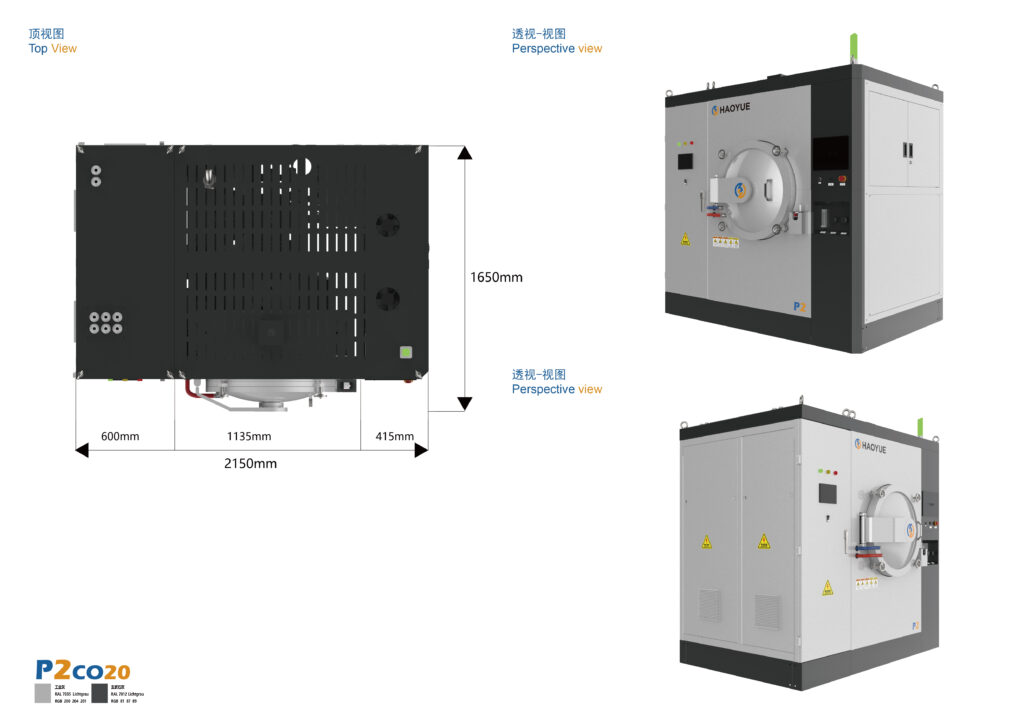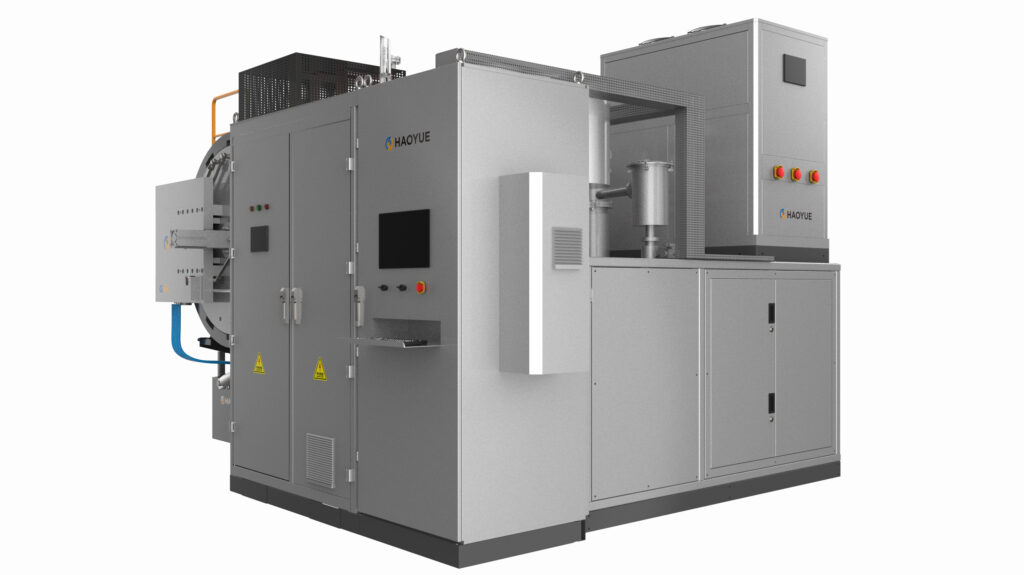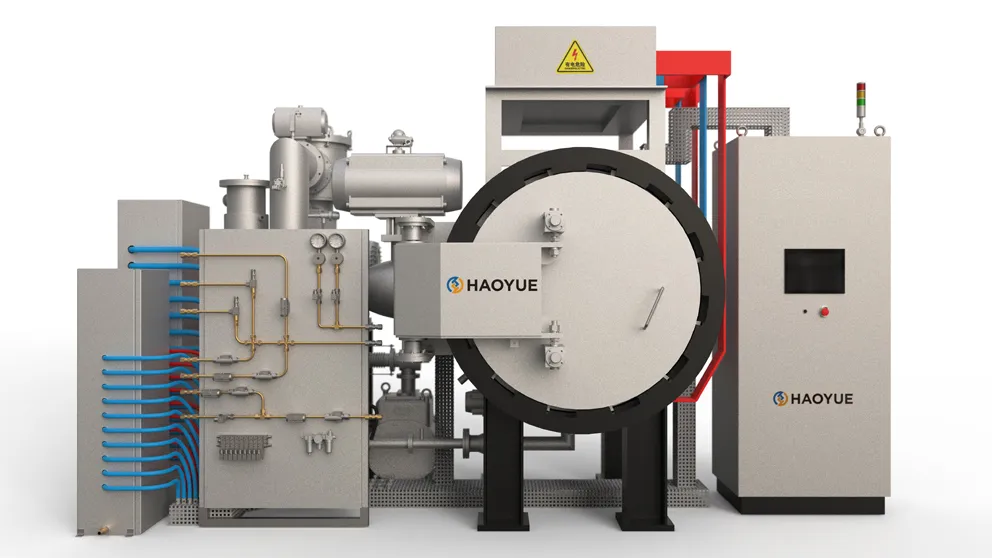
A single chamber vacuum furnace is a vacuum vessel in which pump-down, heating, soak, cooling and unloading all take place in the same space, so the load is never transferred between chambers and never leaves vacuum mid-sequence. That reads like the simplest machine on the market. It is better read as a statement about where a process can be sequenced, and what every cycle pays for it.
Buyers compare chamber volume and maximum temperature first. Both appear on the data sheet whether the vessel is one chamber or three, so the architecture question gets skipped until the second furnace.
What “single chamber” does and does not mean
What it does not mean:
- Not a vacuum class. The same vessel can run at 1 Pa on a mechanical pump only, or at 6.7×10⁻³ Pa with a diffusion or molecular pump. The pump set decides the vacuum, not the chamber count.
- Not a temperature class. 1000/1300 °C on molybdenum and 2000/2400 °C on graphite share the same vessel geometry; the hot zone material sets the ceiling.
- Not a synonym for entry level. One vessel can carry a five-step sequence from dewax to pressure sintering at 6/10 MPa.
What it does mean:
- One sealing boundary to inspect and maintain.
- One hot zone that travels from ambient to process temperature and back, on every cycle.
- A process sequence that runs without breaking vacuum — no hot load transfer, no re-pumping of a chamber that was allowed to go cold.
How a single-chamber cycle actually runs
Stage 1 — Pump-down is a load problem, not a volume problem
The pump removes the chamber volume once. After that it removes what the load and hot zone release: water on part surfaces, residue in a pressed or MIM preform, gas held in porous insulation. The rate falls as surfaces dry — two loads of identical mass can differ by hours if one sat open in a humid shop.
The consequence is specific to this architecture: a single chamber vacuum furnace pumps the entire product load every cycle, while a transfer machine pumps a small lock volume and leaves the main chamber under vacuum — it is not pumping your parts, it is pumping air.
Stage 2 — Heating the hot zone as well as the load
There is no convection worth modelling in vacuum: heat arrives by radiation and leaves by conduction down the hearth supports into the water-cooled shell. In a single chamber the insulation, hearth and fixturing start cold every cycle and come up with the load — stored heat that a permanently hot chamber never spends.
Stage 3 — Soak, and how uniformity is actually proven
±5 °C is a claim about a survey, not a property of a vessel: five points, 1000 °C, held 1 h on our box chambers and 2 h on the hot presses. Long hot zones need independent zone trim, and the survey is repeated after a heater or insulation change.
Stage 4 — The steps that only work in one chamber
Here architecture stops being about throughput. The G series runs positive-pressure dewax, vacuum dewax, vacuum sintering, partial-pressure sintering and pressure sintering up to 6/10 MPa at 1600/2000 °C in a single vessel. Every one of those steps would otherwise require transferring a hot, fragile, partly densified load.
The plumbing is the price: a roughing path for the dewax stage keeps binder vapour out of the high-vacuum pump, a cold trap holds what gets through, and the valve sequence must stop one pressure step from being pulled backwards by the next. Wrong valving makes a single chamber worse than two, because everything the load releases stays in the room with it.
Stage 5 — Cooling and venting in the gas that did the work
Cooling happens in the same volume, with an optional 2 bar fast cool on the V, P and D series. Two things differ from a machine with a separate cooling chamber: the hot zone returns its stored heat to the gas, so the cooling curve has a long tail; and whatever condensed on the cold wall during heat-up is still in the vessel, at reduced pressure, with a path back to the load.
Backfilling with clean inert gas before the cooling ramp, and keeping a periodic burn-off in the schedule, manages it. Skipping it shows up as discoloration on the top layer of the load and an appearance reject that gets blamed on the material.
Key parameters, and what one chamber changes
| Parameter | What it controls | Single-chamber consequence |
|---|---|---|
| Chamber volume vs load volume | Pump-down time, gas consumption | Dead volume above the load is pumped and heated every cycle |
| Hot zone thermal mass | Heat-up and cool-down duration | Insulation and hearth cycle with the load instead of staying hot |
| Pump set | Vacuum class: 1 Pa mechanical vs 6.7×10⁻³ Pa diffusion/molecular | Any class is available; it is an order option, not an architecture limit |
| Valve and cold-trap layout | Whether dewax vapour reaches the high-vacuum pump | One vessel must route its own roughing and high-vacuum paths |
| Zone count | ±5 °C at 1000 °C | Long chambers need independent top, middle and bottom trim |
| Cooling gas path | Distortion, cycle time | Gas meets a hot insulation stack, not a cold chamber wall |
Single-chamber models in our range
| Series | Model | Chamber (mm) | Hot zone | Vacuum | Max temp / load |
|---|---|---|---|---|---|
| V (sintering) | V3GR24 – V8GR24 | 300×300×400 – 800×800×1200 | GR | 6.7×10⁻³ Pa | 2000/2400 °C |
| V (sintering) | V3W20 – V6W20 | 300×300×400 – 600×600×900 | W | 6.7×10⁻³ Pa | 1800/2000 °C |
| V (sintering) | V4M013 – V10M013 | 400×400×600 – 1000×1000×1400 | MO | 6.7×10⁻³ Pa | 1000/1300 °C |
| V (induction) | V6CO24 / V8CO24 | 600×600×900 / 800×800×1200 | CO | 5 Pa | 2000/2400 °C |
| H (vacuum hydrogen) | H4M013 – H8M013, HV6S/120 | 400×400×600 – 800×800×1200, Φ650×1200 | MO | 6.7×10⁻³ Pa | 1000/1300 °C |
| G (gas pressure) | G3H / G9H | 300×300×1000 / 500×500×1800 | GR | 10 Pa, 6/10 MPa | 1600/2000 °C |
| P (hot press) | P3VGR22 – P11VGR22 | Φ300×400 – Φ1100×900 | GR | 6.7×10⁻² Pa; 1 or 6.7×10⁻³ Pa on P5–P11 | 2200 °C, 100–1200 t |
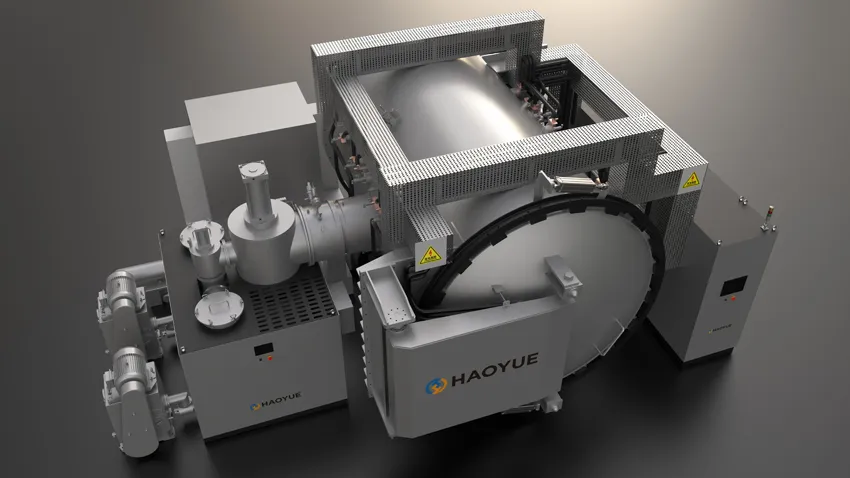
The P5VTGR22-II and P7VTGR22-II are that class with a second chamber added: two chambers sharing one vacuum system, one fast-cool circuit, one vessel and one control set, side-opening, 400 mm double-stroke ram. It adds a load position without duplicating the plant, and is still a batch machine.
Two rows deserve a second look: 5 Pa on the induction V models is a pump-set class, not a grade, and 6.7×10⁻³ Pa on the graphite models needs a diffusion or molecular pump.
Single chamber vs double chamber vs continuous
| Criterion | Single chamber | Double chamber (shared services) | Continuous multi-station |
|---|---|---|---|
| Loads in process | One | Two — one heating while the other cools | Several, at fixed stations |
| Cycle time driver | Pump-down + heat-up + soak + cool | Soak, mostly | Station takt |
| Condensate control | Everything stays in the vessel | Split across two vessels | Segregated by station |
| Floor space and services | Smallest | Moderate; shares pumps and cooling | Largest |
| Flexibility for R&D | Highest — any recipe, any load | Good | Low; one recipe per line |
| Failure mode | Throughput | Two sealing boundaries to maintain | Small batches, high mix |
Applications where one vessel is the right answer
- Job shops and tool rooms. Mixed loads and changing recipes: a V6GR24 at 600×600×900 mm covers tool steel, carbide and ceramic work without re-configuring a line.
- Dewax and sinter in one pull. MIM and pressed carbide parts go from binder removal to closed porosity without a hot transfer: the G series sequence at 6/10 MPa, or a molybdenum V chamber at 1000/1300 °C with hydrogen debinding.
- Research and pilot production. Hot pressing, SPS and vacuum sintering recipes change faster than a transfer line can be re-tooled; a P series chamber at 2200 °C and 100–1200 t is re-programmed, not rebuilt.
- Brazing, metallizing and glass-to-metal sealing. The H series combines vacuum and hydrogen in one vessel at 1000/1300 °C, which is what oxide reduction ahead of a braze cycle needs.
- Large single pieces. A 1000×1000×1400 mm MO chamber or a Φ1100×900 mm hot-press chamber has no equivalent in a multi-station layout.
Limitations — when a single chamber is the wrong purchase
- Throughput is the real constraint. If the line needs a fixed number of loads per shift and the recipe never changes, this architecture pays for flexibility in idle time.
- The process releases heavy condensate. High-organic binder loads, or metals with meaningful vapour pressure at temperature, deposit material on the cold wall that returns during cool-down. Two chambers, or a burn-off schedule written into production, is the honest answer.
- The metallurgy needs a fast quench from temperature. A single chamber cools in place. A 2 bar fast cool is not a quench press, and nothing here substitutes for moving the load into a cold zone.
- Steps need different atmospheres with no cross-talk. Hydrogen, then high vacuum, then nitrogen at pressure in one vessel is achievable — the H and G series do it — but the valving and purge volume must be designed for it; a standard build will not.
- A cycle time is quoted without its pump-down term. Ask what it assumes about load surface area and storage. A pump-down measured on an empty, dry chamber is not a production cycle time.
FAQ
What is a single chamber vacuum furnace?
A vacuum vessel in which pump-down, heating, soak, cooling and unloading all occur in the same space, so the load is never transferred between chambers. One sealing boundary, one hot zone, and one thermal mass that cycles with the load.
Is a single chamber furnace lower quality than a double chamber?
No. Chamber count is a throughput and condensate decision. The ceiling comes from the hot zone material — 1000/1300 °C on molybdenum, 2000/2400 °C on graphite — and the vacuum class from the pump set: 1 Pa on a mechanical pump only versus 6.7×10⁻³ Pa with a diffusion or molecular pump. On P5–P11 that is an order option.
How long does one cycle take?
There is no general number. It is pump-down (set by load surface area and storage), heat-up (set by hot zone mass and ramp rate, 1–15 °C/min below 1600 °C and 1–10 °C/min above), soak, any pressure steps, and cooling. Ask for each term separately rather than for a total.
Can a single chamber debind and sinter in one cycle?
Yes. The G series runs positive-pressure dewax, vacuum dewax, vacuum sintering, partial-pressure sintering and pressure sintering at 6/10 MPa in one vessel. It needs the roughing path, cold trap and valve sequence that keep binder vapour out of the high-vacuum pump.
Does one chamber lose temperature uniformity?
Not inherently. ±5 °C is certified by a five-point survey at 1000 °C, held 1 h on box chambers and 2 h on hot presses, and long chambers need independent zone trim to reach it. What this layout does add is a hot insulation stack in the cooling path, which lengthens the tail of the cooling curve.
When should I buy two chambers instead of one?
When loads per shift is the constraint, or when the process releases enough condensate that cooling in the same vessel contaminates the load. The P5VTGR22-II and P7VTGR22-II add a second chamber on shared vacuum, cooling and controls: capacity without a second plant.