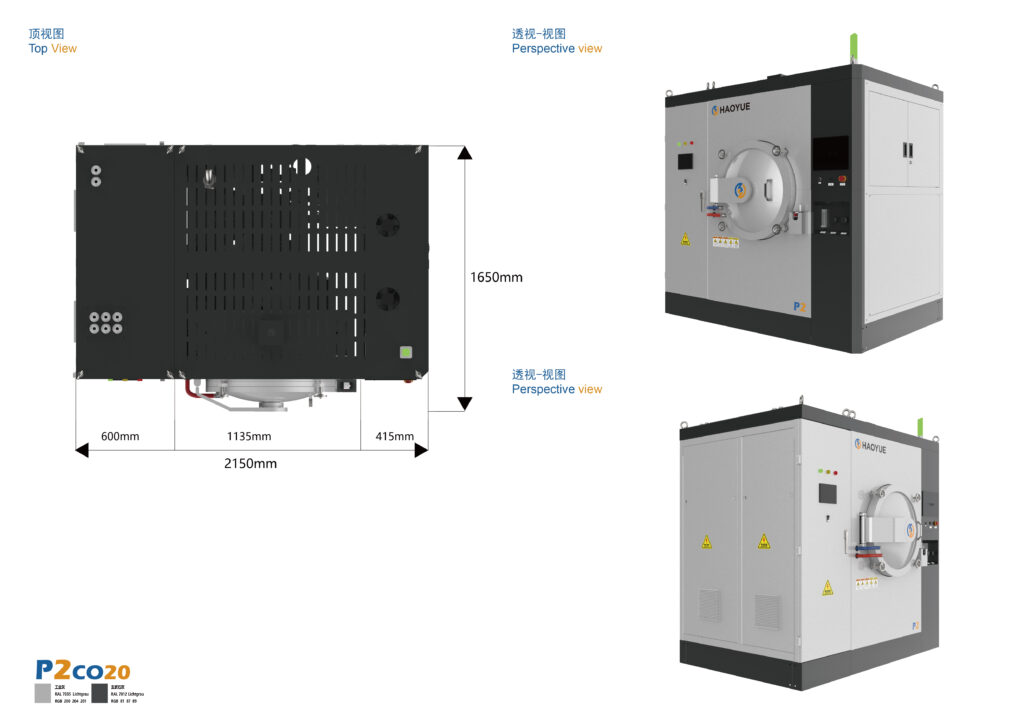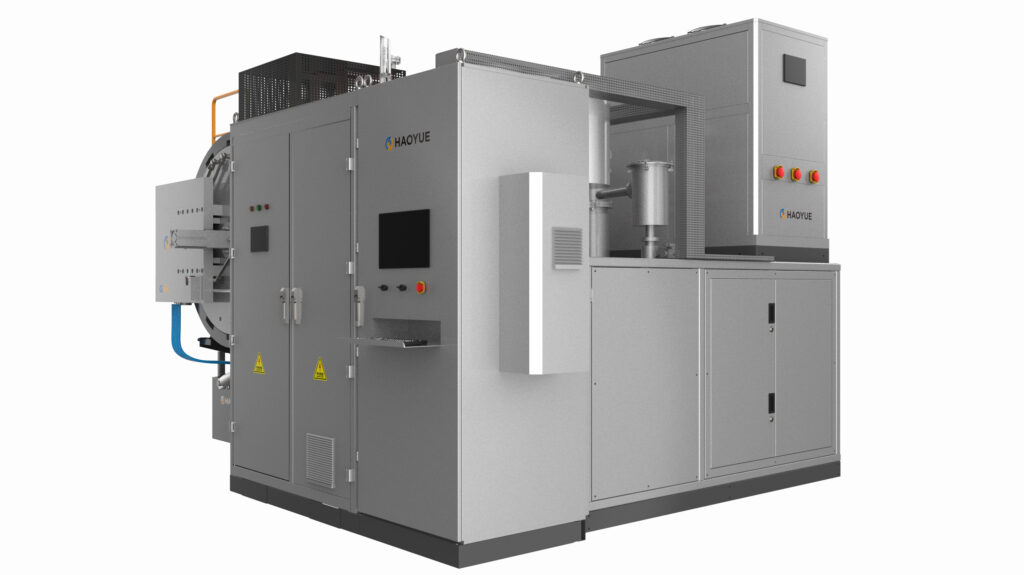




Hot isostatic pressing (HIP) is a densification process that applies equal gas pressure from every direction — typically 100 to 200 MPa of argon — to a part held at high temperature, so internal porosity collapses by plastic flow, creep and diffusion instead of by melting. It is a pore-closure step, not a sintering step: the part must already be consolidated, and the pores must already be closed.
That single distinction explains most of the mis-buying we see. Plants ask for HIP when what they actually need is a sinter-HIP cycle, or a gas pressure sinter, or a uniaxial hot press — and pay two to three times the capital cost for capability their part geometry cannot use.
What HIP actually does — and what it does not
Three variables act together inside the vessel, and each has a different job:
- Pressure supplies the driving force that collapses a pore. 100 MPa is roughly 1,000 bar — enough to close a spherical void in a metal at temperature in minutes rather than months.
- Temperature gives the material the ability to deform. Below roughly half the absolute melting point, most alloys creep too slowly for the cycle to be economic; HIP temperatures are usually set at 0.5–0.7 of the melting point in kelvin, which is why superalloys run near 1,200 °C and ceramics near 1,800–2,000 °C.
- Time lets diffusion heal the collapsed pore interface. One to four hours at hold is typical for production cycles; longer holds buy little once the pore is bonded.
What HIP does not do is equally important. It cannot densify a part with connected porosity — argon simply enters the pore network, and when the vessel depressurises the gas is trapped inside, leaving a part that is worse than before. As a rule of thumb, HIP is applied once a part has reached roughly 92–95% of theoretical density with isolated pores, whether by sintering, casting or additive manufacturing.
It also cannot change chemistry, remove inclusions, or repair cracks that reach the surface. A HIP vessel is a press, not a purification step.
How a HIP cycle runs, stage by stage
1. Load and seal. Parts go into the hot zone either bare (capsule-free) or inside a shaped container (canned). Capsule-free works when the surface porosity is already closed and the geometry can tolerate isostatic load. Canned HIP is used for loose powder, for near-net preforms and for anything where the surface must be fully dense — the container transmits pressure and is later removed by machining or pickling.
2. Evacuate and leak-check. The vessel is pumped down, then backfilled with argon. On our I-series systems the vacuum specification is 100 Pa, which is a mechanical-pump base configuration — and that is deliberate. The vessel spends most of its life at 100–200 MPa of argon, not under vacuum; the pump-down exists to remove air and moisture before pressurisation, not to run a high-vacuum process. Reading the 100 Pa figure as a “high vacuum” rating is a common specification error.
3. Pressurise and heat simultaneously. Argon is admitted while the hot zone ramps. Compressing cold gas is cheaper than compressing hot gas, so most recipes start pressurising early and let pressure and temperature arrive together.
4. Hold. Pressure is held at the set point for the dwell time while the load sits within the qualified temperature band.
5. Depressurise and cool. This is the stage that decides throughput. A pressurised vessel cannot be quenched the way a vacuum furnace can, so cooling is by gas circulation and is inherently slower. Where a HIP-ed part needs a specific microstructure, the heat treatment is normally a separate vacuum cycle afterwards.
Key parameters and what each one controls
| Parameter | What it controls in practice | I-series values |
|---|---|---|
| Maximum pressure | Pore-closure driving force; also vessel wall thickness and cost | 100 / 150 / 200 MPa |
| Maximum temperature | Which material families are addressable | 2000 °C with C/C heater; 1400 °C with molybdenum heater |
| Vacuum level | Pump-down before backfill, not process vacuum | 100 Pa |
| Hot zone size | Largest part or batch envelope | Φ500 × 1000 mm; Φ1000 × 2000 mm |
| Loading direction | Handling, floor height and crane access | Top loading |
| Heating element | Temperature ceiling and contamination risk | Carbon/carbon composite or molybdenum |
| Pressure medium | Inertness and cooling speed | Argon; helium where faster cooling is needed (typical) |
The heater choice is the constraint buyers underestimate. A carbon/carbon hot zone reaches 2000 °C and is mechanically robust, but it is a carbon source — acceptable in argon for most metals and ceramics, less so where carbon pickup matters. A molybdenum hot zone is carbon-free but caps the process at 1400 °C.
I-series HIP systems
| Model | Hot zone | Heater | Max temperature | Max pressure | Vacuum | Loading |
|---|---|---|---|---|---|---|
| I5CC20 | Φ500 × 1000 mm | C/C composite | 2000 °C | 100 / 150 / 200 MPa | 100 Pa | Top |
| I10M014 | Φ1000 × 2000 mm | Molybdenum | 1400 °C | 100 / 150 / 200 MPa | 100 Pa | Top |
Both frames share the same pressure ratings; the difference is what the hot zone allows you to run. A 2000 °C C/C chamber is the only one of the two that can HIP silicon nitride or transparent spinel, while the 1400 °C molybdenum chamber suits superalloys, titanium and aluminium alloys where carbon contamination is a real risk. Full specifications are on the I5 HIP system page.
HIP versus sinter-HIP, GPS and vacuum hot pressing
The decision is not “which route is best” but “which route matches the porosity state and the geometry”.
| Route | Driving force | Pressure | Temperature ceiling | Shape freedom | Main limitation |
|---|---|---|---|---|---|
| Pressureless vacuum sintering | Surface energy only | — | 2400 °C with graphite hot zone | High | Residual porosity of 1–5% typical |
| Vacuum hot pressing | Uniaxial load | 100–1200 t | 2200 °C | Low — discs, blocks, simple sections | Pressure gradient along the axis |
| Gas pressure sintering (GPS) | Inert gas overpressure | 6 / 10 MPa | 2000 °C | Medium to high | Pressure too low for full closure in hard metals |
| Sinter-HIP (single cycle) | Gas overpressure during cooling | 6 / 10 MPa | 2000 °C | Medium | Same 6–10 MPa ceiling as GPS |
| HIP | Isostatic gas pressure | 100 / 150 / 200 MPa | 2000 °C (C/C) / 1400 °C (Mo) | Medium — needs capsule or closed surface | Cannot fix connected porosity; slow cooling |
The number that matters in that table is the pressure ratio. Sinter-HIP at 6–10 MPa is one-tenth to one-twentieth of a HIP cycle at 100–200 MPa. For cemented carbide cutting inserts, sinter-HIP in a graphite chamber is usually enough and is far cheaper per part; the horizontal GPS platform runs that integrated debinding–sinter–pressure cycle in one load. HIP earns its cost when the pore is large, the material is creep-resistant, or the part is a casting or an additive-built component with irregular internal voids.
Uniaxial hot pressing solves a different problem. It reaches 2200 °C and applies a directed load up to 1200 t, which is the right answer for a disc or a billet where a pressure gradient is acceptable and the shape is simple — see the P-series vacuum hot pressing platform. It is not a substitute for isostatic pressure on a complex part.
Applications where HIP is the correct answer
- Investment castings for aerospace and energy — closure of shrinkage porosity and micro-shrinkage in nickel-based superalloy turbine hardware.
- Titanium and TiAl components — densification without the alpha-case growth that vacuum annealing alone cannot remove.
- Powder metallurgy near-net parts — canned HIP of superalloy or titanium powder to full density with a fine, uniform grain structure.
- Additive manufacturing — internal porosity in laser powder-bed parts is the dominant fatigue initiator; HIP below the sintering temperature closes it without coarsening the microstructure excessively.
- Diffusion bonding — the same vessel can bond dissimilar materials under isostatic load, a route used for clad plates and multi-layer assemblies.
- Medical implants and cobalt-chrome or titanium castings where fatigue life is a regulatory, not commercial, requirement.
Limitations: when HIP is the wrong choice
1. The porosity is connected. No capsule, no closed surface, no result. Pre-sinter, pre-cast or can the part first — otherwise the cycle converts a marginal part into scrap.
2. The part is simple and made in volume. A bushing, a plate or an insert that a sinter-HIP cycle brings to full density does not need 100 MPa. The capital and the cycle time will not pay back.
3. Tolerances are tight and walls are thin. Isostatic pressure is uniform, but the thermal cycle is not free of distortion, and thin sections move. Budget machining allowance, or expect a straightening operation.
4. Batch loading is small relative to the vessel. HIP economics are dominated by fill factor. A vessel that runs at 30% loading carries the same argon, the same pump-down and the same labour as one at 80%.
5. Cooling rate is part of the specification. If the required microstructure depends on a fast cool, HIP alone will not deliver it; plan a separate vacuum heat treatment and accept the extra cycle.
6. The problem is chemistry, not density. Inclusions, decarburisation and segregation survive HIP untouched.
FAQ
What pressure and temperature does HIP use?
Our I-series vessels run at 100, 150 or 200 MPa of argon with a 2000 °C carbon/carbon hot zone or a 1400 °C molybdenum hot zone. Hold times of one to four hours are typical, set by the material’s creep behaviour rather than by the vessel.
What is the difference between HIP and sinter-HIP?
Sinter-HIP pressurises the same chamber during sintering and cooling, at 6–10 MPa. HIP uses a separate vessel at 100–200 MPa on an already-consolidated part. Sinter-HIP is cheaper per part; HIP closes porosity that 10 MPa cannot.
Can HIP densify a part that was never sintered?
Yes, but only inside a can. Loose or loosely compacted powder must be encapsulated so the gas pressure has something to act on. Capsule-free HIP requires closed surface porosity.
Does HIP change part dimensions?
Slightly. Density increases, so volume shrinks by the amount of porosity removed — typically well under 2% linear for a 95%-dense preform, but enough to matter on a tolerance-critical feature.
Why is the vacuum specification only 100 Pa?
Because the process runs at pressure, not under vacuum. The 100 Pa figure describes the mechanical-pump pump-down used to remove air before argon backfill. It is not a high-vacuum rating and should not be compared with a diffusion-pumped sintering furnace.
Is HIP necessary for every additive manufactured part?
No. It is necessary where internal porosity drives fatigue life or where a specification calls for it. For non-critical geometry, a stress relief cycle and hot isostatic pressing are not interchangeable line items — the choice should come from the fatigue requirement, not from habit.
If you are weighing HIP against sinter-HIP or hot pressing for a specific part, send us the material, the expected density and the section thickness — that is usually enough for us to tell you which route the geometry actually supports.