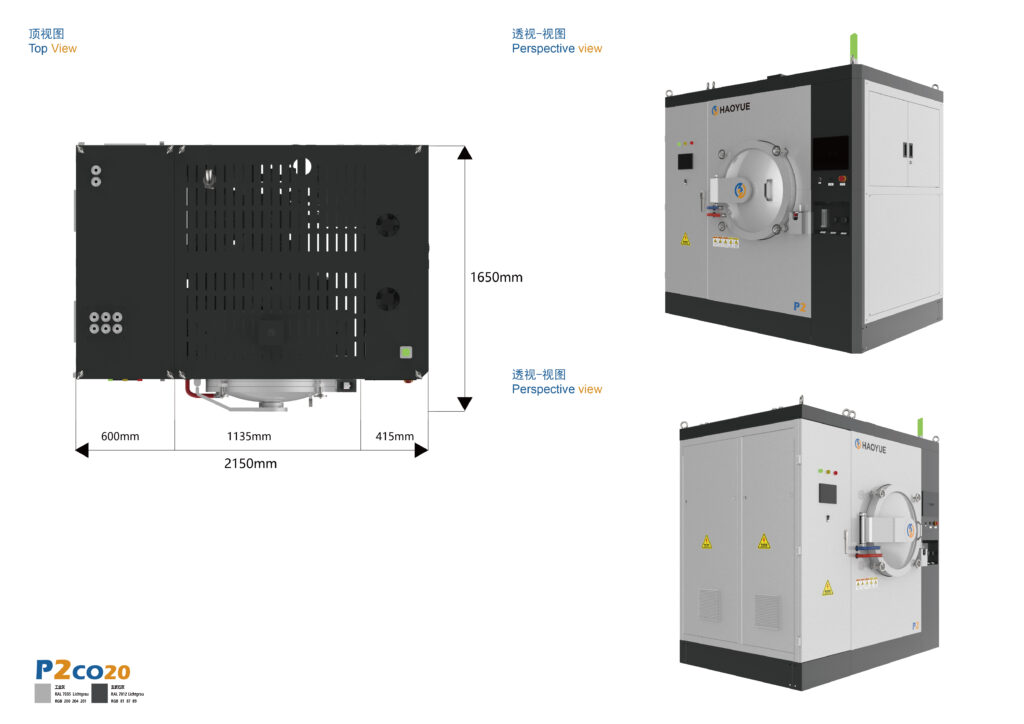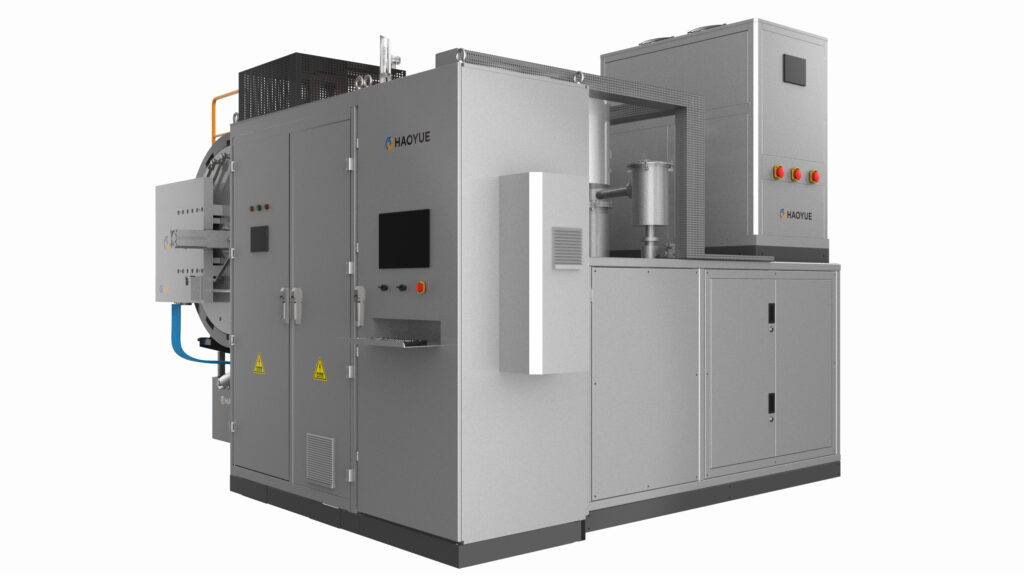






A graphite vacuum furnace is a vacuum furnace whose hot zone — heating elements, radiation shielding, and often the internal furniture — is manufactured from graphite, which allows continuous operation at 2000 °C or 2400 °C under high vacuum or inert gas. In practice, the phrase is used two ways: for a furnace that processes graphite and carbon products, and for a furnace built with a graphite hot zone. Both meanings point to the same engineering decision, and that decision is the subject of this guide.
Most buyers who search for graphite vacuum furnaces are not looking for a definition. They are trying to answer three questions: will a graphite hot zone survive my atmosphere, will it contaminate my parts, and how much maintenance am I signing up for. This article answers those in that order, with the parameter ranges we build to.
What Is a Graphite Vacuum Furnace?
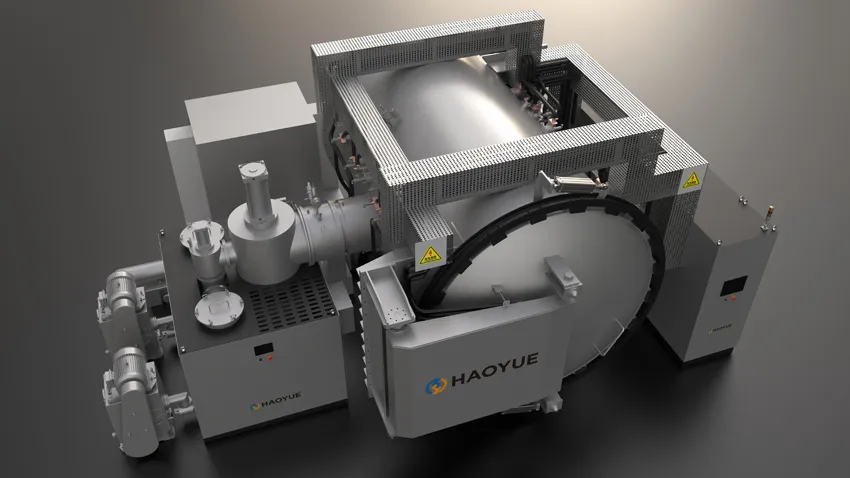
A hot zone is the insulated inner chamber of a vacuum furnace: the heating elements, the radiation shields that keep heat in and protect the vessel, and the hearth or rack that carries the load. In a graphite vacuum furnace, those components are graphite — typically isostatic or extruded graphite for elements, and graphite felt or rigid graphite board for insulation.
Graphite is chosen for a specific combination of properties that few materials match at once:
- Sublimation instead of melting. Graphite does not melt at atmospheric pressure; it sublimes at a temperature far above any vacuum furnace operating range. It also gets stronger as temperature rises, in contrast to metals.
- Low thermal mass. Graphite hot zones heat and cool faster than all-metal hot zones of equivalent volume, which shortens cycle time and reduces energy per batch.
- Machinability and repairability. Elements, shields, and fixtures can be machined and replaced piece by piece rather than scrapped as an assembly.
- Cost at temperature. Above roughly 1600 °C, graphite remains far more economical than refractory-metal hot zones of comparable volume.
The trade-offs are equally specific: graphite is a carbon source, it oxidises, and it is a consumable. Those three facts drive every limitation in the second half of this article.
How a Graphite Vacuum Furnace Works
Stage 1 — Evacuation
The chamber is pumped down before heat is applied. Our V-series graphite hot zone furnaces are specified at an ultimate vacuum of 6.7 × 10⁻³ Pa, which is a high-vacuum level reached with a diffusion pump or molecular pump — not with a mechanical pump alone. Getting to that level matters less for the number itself than for what it removes: oxygen and water vapour, which attack graphite at temperature.
Stage 2 — Outgassing and binder removal
Below the sintering range, the load releases adsorbed moisture, forming lubricants, and binder residues. In powder metallurgy and MIM work this stage is a process in its own right; the ramp is slow and the vacuum system is sized for the gas load, not just for the empty-chamber pumpdown. Rushing this stage is the most common cause of a hot zone that ages prematurely.
Stage 3 — Controlled ramp
Our V-series graphite hot zone furnaces run at 1–15 °C/min below 1600 °C and 1–10 °C/min above 1600 °C. The rate slows at high temperature deliberately: the limiting factor is not the heater’s capability but the thermal gradient the load can tolerate without cracking. Multi-zone temperature control and industrial PC + PLC + PID regulation hold the profile, with a measured uniformity of ±5 °C on a five-point survey at 1000 °C held for one hour.
Stage 4 — Soak
Peak temperature is set by the material, not by the furnace. A furnace rated to 2400 °C is not an instruction to run at 2400 °C; most production recipes sit well below the rating because grain growth, volatilisation, and hot zone life all get worse as you approach it.
Stage 5 — Controlled cooling
Free cooling under vacuum is slow at the top of the range. An optional 2 bar gas quench is available on the V series for applications where cooling rate affects microstructure or where throughput justifies the gas cost.
Key Parameters
| Parameter | Specification / typical range | Why it matters |
|---|---|---|
| Hot zone material | Graphite (heating elements, insulation, furniture) | Sets the temperature ceiling and the contamination profile |
| Maximum temperature | 2000 °C or 2400 °C (configuration-dependent) | Two ratings exist; specify which one you are buying |
| Ultimate vacuum | 6.7 × 10⁻³ Pa (diffusion or molecular pump) | High-vacuum level; protects graphite and cleans surfaces |
| Working atmosphere | High vacuum, or inert gas (argon / nitrogen¹) | Graphite is not compatible with oxidising atmospheres |
| Heating rate | 1–15 °C/min (< 1600 °C); 1–10 °C/min (> 1600 °C) | Gradient control, not heater power, is the limit |
| Temperature uniformity | ±5 °C (5-point survey, 1000 °C, 1 h hold) | The number to ask for on acceptance testing |
| Chamber size | 300 × 300 × 400 mm to 800 × 800 × 1200 mm | Load geometry drives choice more than peak temperature |
| Cooling | Vacuum cooling; optional 2 bar gas quench | Affects cycle time and as-cooled microstructure |
| Control | Industrial PC + PLC + PID, multi-zone | Recipe repeatability and traceability |
¹ Nitrogen is inert to graphite but reactive to some alloys at temperature — check the material, not just the hot zone.
What Our Graphite Vacuum Furnaces Actually Deliver
V series — graphite hot zone, pressureless
| Model | Chamber (mm) | Ultimate vacuum | Max temperature | Heating rate |
|---|---|---|---|---|
| V3GR24 | 300 × 300 × 400 | 6.7 × 10⁻³ Pa | 2000 / 2400 °C | 1–15 °C/min (< 1600 °C); 1–10 °C/min (> 1600 °C) |
| V4GR24 | 400 × 400 × 600 | 6.7 × 10⁻³ Pa | 2000 / 2400 °C | same |
| V6GR24 | 600 × 600 × 900 | 6.7 × 10⁻³ Pa | 2000 / 2400 °C | same |
| V7GR24 | 700 × 700 × 1000 | 6.7 × 10⁻³ Pa | 2000 / 2400 °C | same |
| V8GR24 | 800 × 800 × 1200 | 6.7 × 10⁻³ Pa | 2000 / 2400 °C | same |
All V-series graphite hot zone models carry ±5 °C uniformity (five-point survey at 1000 °C, 1 h hold), multi-zone control, and the optional 2 bar fast-cooling package.
P series — graphite hot zone with uniaxial pressure
When pressureless sintering cannot close the last few percent of porosity, the same graphite hot zone principle is combined with a hydraulic ram:
| Model | Chamber (mm) | Sample dia. | Press force | Ultimate vacuum | Max temperature |
|---|---|---|---|---|---|
| P3VGR22 | Φ300 × 400 | Φ150 | 100 ton | 6.7 × 10⁻² Pa | 2200 °C |
| P5VGR22 | Φ500 × 700 | Φ300 | 300 ton | 1 Pa or 6.7 × 10⁻³ Pa (pump option) | 2200 °C |
| P7VGR22 | Φ700 × 900 | Φ400 | 600 ton | 1 Pa or 6.7 × 10⁻³ Pa (pump option) | 2200 °C |
| P9VGR22 | Φ900 × 900 | Φ500 | 800 ton | 1 Pa or 6.7 × 10⁻³ Pa (pump option) | 2200 °C |
| P11VGR22 | Φ1100 × 900 | Φ600 | 1200 ton | 1 Pa or 6.7 × 10⁻³ Pa (pump option) | 2200 °C |
P-series units hold pressure to better than ±3%, use bellows-sealed upper and lower rams, and are specified at ±5 °C uniformity on a five-point survey at 1000 °C held for two hours. Heating rate is 1–10 °C/min below 1600 °C and 1–15 °C/min above 1600 °C.
A note on that vacuum column. The “1 Pa or 6.7 × 10⁻³ Pa” entry is not a range — it is a pump configuration choice. 1 Pa is a mechanical-pump (rough vacuum) level with no diffusion or molecular pump fitted; 6.7 × 10⁻³ Pa is the high-vacuum configuration. If your process genuinely needs high vacuum, specify the pump package, not just the furnace model.
Graphite vs. Other Hot Zones
| Hot zone | Max temperature (our range) | Ultimate vacuum | Choose it when | Avoid it when |
|---|---|---|---|---|
| Graphite (V-GR) | 2000 / 2400 °C | 6.7 × 10⁻³ Pa | Carbon and graphite products, C/C composites, technical ceramics, cemented carbide, refractory alloys; highest temperature per unit cost | Parts are carbon-sensitive; process needs hydrogen or any oxidising species |
| Tungsten (V-W) | 1800 / 2000 °C | 6.7 × 10⁻³ Pa | Transparent and technical ceramics, SiC, Si₃N₄, refractory metals where carbon pickup is unacceptable | You need 2200 °C+; budget is constrained |
| Molybdenum (V-MO) | 1000 / 1300 °C | 6.7 × 10⁻³ Pa | Non-ferrous metals, stainless steel, titanium alloys, superalloys, cemented carbide at lower temperature, and all hydrogen work (H series) | Process runs above 1300 °C |
| Induction (V-CO) | 2000 / 2400 °C | 5 Pa | Very fast heating is required (1–60 °C/min below 1600 °C), large graphite or C/C loads | High vacuum is required — 5 Pa is a lower pump configuration, not a high-vacuum level |
Applications
Graphite vacuum furnaces are used in two overlapping worlds.
Processing carbon and graphite itself: graphite electrodes, graphite products and blocks, carbon paper and carbon cloth, carbon/carbon brake discs and plates, graphene and carbon nanotube feedstock, thermally conductive films, and hot-zone materials for other furnaces. Here the graphite hot zone is not just convenient — it is chemically the right environment.
Processing materials that tolerate or need a carbon-bearing environment: technical and transparent ceramics, cemented carbide, refractory alloys, and powder metallurgy parts. Our P-series graphite vacuum hot pressing furnace is used for silicon nitride, silicon carbide, boron carbide, boron nitride, copper- and iron-based powder materials, aircraft brake discs, and armour plate — where uniaxial pressure and a graphite environment combine to reach densities that pressureless sintering cannot.
Limitations: When a Graphite Vacuum Furnace Is the Wrong Choice
This is the section most supplier pages skip.
- Any oxidising or oxygen-bearing atmosphere. Graphite oxidises at elevated temperature in the presence of oxygen — this is the one hard boundary. Graphite hot zones run under vacuum or inert gas. If your process needs air, oxygen, or a wet oxidising atmosphere, a graphite hot zone is not a candidate at any price.
- Carbon-sensitive materials. A graphite hot zone is a carbon source. For titanium alloys, low-carbon stainless grades, and alloys where interstitial carbon changes mechanical or magnetic properties, consider a tungsten hot zone (V-W, 1800/2000 °C) or a molybdenum hot zone (V-MO, 1000/1300 °C) instead. In our experience this is the most commonly under-specified risk in a purchase enquiry.
- Hydrogen processes. Hydrogen at temperature reacts with graphite to form hydrocarbons, consuming both. Vacuum-hydrogen work belongs on an H-series furnace with a molybdenum hot zone (6.7 × 10⁻³ Pa, 1000/1300 °C).
- Processes that need pressure to densify. If pressureless sintering leaves residual porosity, the answer is a P-series hot press (100–1200 ton uniaxial), a G-series gas pressure sintering furnace (6 or 10 MPa, 1600/2000 °C), or hot isostatic pressing — not a hotter graphite furnace.
- Long, low-temperature duty cycles. If you never exceed 1300 °C, a molybdenum hot zone is the more economical specification; you are paying for a temperature capability you will not use.
- Nanostructure retention. Graphite vacuum furnaces heat at 1–15 °C/min. If your material’s value is in a nanocrystalline or metastable microstructure, spark plasma sintering (up to 300 °C/min, 2200 °C) is the relevant technology.
- The hot zone is a consumable. Elements, felt, and fixtures degrade with thermal cycling, outgassing load, and peak temperature. Budget for periodic replacement and keep a spare set. Anyone who quotes you a graphite hot zone with no maintenance schedule is not giving you a full cost picture.
FAQ
What temperature can a graphite vacuum furnace reach?
Our V-series graphite hot zone furnaces are rated to 2000 °C or 2400 °C depending on the specified configuration — two ratings, not a single number. Our P-series graphite vacuum hot pressing furnaces are rated to 2200 °C.
What vacuum level does a graphite vacuum furnace achieve?
Our V-series graphite hot zone models are specified at 6.7 × 10⁻³ Pa, a high-vacuum level that requires a diffusion pump or molecular pump. Lower levels such as 1 Pa or 5 Pa indicate a mechanical-pump-only configuration and should not be described as high vacuum.
Graphite hot zone or tungsten hot zone — which should I choose?
Choose graphite for carbon and graphite products, C/C composites, cemented carbide, and any application above 2000 °C. Choose tungsten (1800/2000 °C) when carbon pickup in the part is unacceptable, as with many transparent ceramics and refractory metals.
Can a graphite vacuum furnace run in a hydrogen atmosphere?
Not normally. Hydrogen reacts with graphite at temperature. Hydrogen annealing, brazing, metallising, and glass-to-metal sealing are run on our H-series vacuum hydrogen furnaces, which use a molybdenum hot zone at 1000/1300 °C.
How large are the chambers?
The V-series graphite hot zone range runs from 300 × 300 × 400 mm (V3GR24) to 800 × 800 × 1200 mm (V8GR24). For pressure-assisted work, the P-series runs from Φ300 × 400 mm (P3VGR22) to Φ1100 × 900 mm (P11VGR22).
Is a graphite vacuum furnace the same as a hot press?
No. A standard graphite vacuum furnace sinters without applied pressure. If your material needs mechanical pressure to reach full density, you need a vacuum hot press — and if it needs pressure from all directions, gas pressure sintering or HIP.
If you are weighing a graphite hot zone against tungsten or molybdenum for a specific material, send us your material system, target density, and part geometry — we will run a trial cycle and return the data before you commit to a specification.
Related equipment: P Series Graphite Vacuum Hot Pressing Furnace · Vacuum Sintering Furnace · 1800 °C High-Temperature Vacuum Furnace