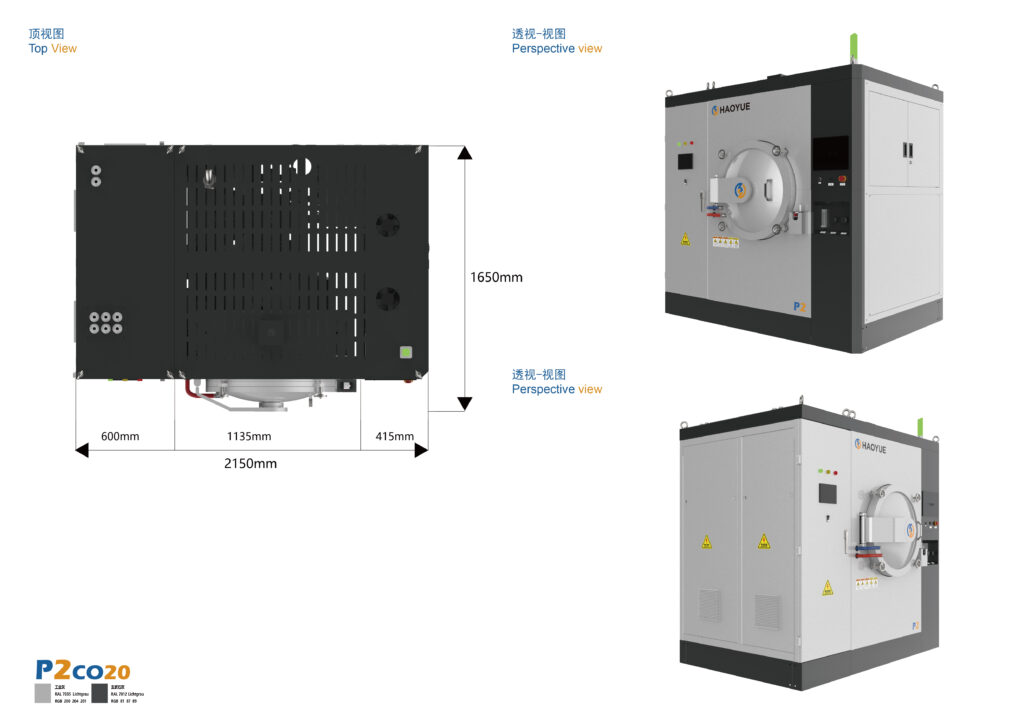
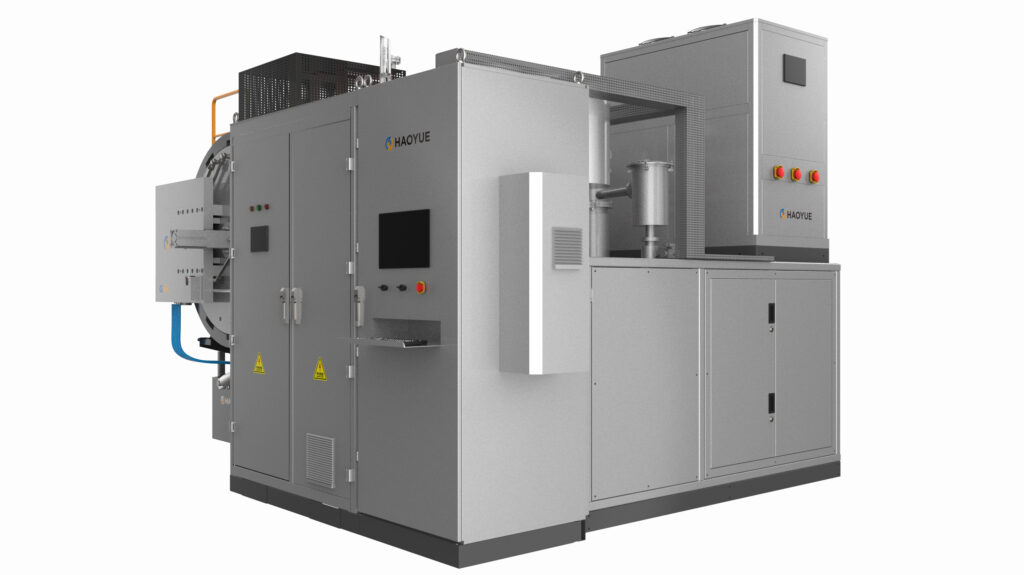
A graphite hot zone is the insulated, resistance-heated working volume of a vacuum furnace — heater, radiation shielding, supports, hearth and nozzles — and it is the subassembly that fixes the temperature ceiling, the uniformity, the vacuum and most of the maintenance cost. Everything outside it is vessel, pumping and control; everything the process touches is hot zone.
Buyers compare furnaces by chamber size and maximum temperature. Operators, a few years in, compare them by how the hot zone behaves in its fourth year.

What a graphite hot zone is — and what it is not
Five groups, each failing differently:
- Heater. Machined graphite tube, rod, strip or plate, segmented so resistance and current density can be set per zone. Slots, bridges and bolt seats carry the highest current density and erode first.
- Insulation. Rigidized felt or rigid board, layered off the water-cooled wall. It keeps radiated power in; it fails by shrinking, cracking and shedding dust.
- Supports. Graphite posts, pins and spacers that locate heater and hearth without rigid clamping, because the stack grows on the way to 2000 °C and returns on the way down.
- Hearth and furniture. Rails, plates, trays, boats — sometimes a different grade from the heater.
- Gas and sensing. Quench nozzles, manifolds, sight paths for thermocouple and pyrometer, water-cooled electrode feedthroughs.
What it is not: a fixed feature of the chamber. Two furnaces with identical vessels can carry different heater grades, zone counts and insulation stacks, and therefore different uniformity, ramp and vacuum behaviour — a spec sheet quoting chamber size and temperature says almost nothing.
Graphite earns its place: at furnace pressures it sublimes rather than melts, and its strength rises into the 2000 °C class. The price is chemistry — graphite is carbon.
How the hot zone behaves over a campaign
Stage 1 — the resistance you do not have when cold
Graphite resistivity falls as it heats, so an element measured cold presents far less resistance at 2000 °C. Power supplies are sized for the hot condition; the cold ramp is limited by thermal stress in the element.
Hence a habit worth adopting on day one: record power at a fixed reference temperature — 1000 °C, where uniformity is also certified — and treat that number as the wear gauge.
Stage 2 — the first pump-down after a shutdown
Graphite is porous and holds water. After a weekend or a humid season it is a gas source, and pump-down to 6.7×10⁻³ Pa takes longer than the figure quoted for an empty, dry chamber.
That moisture is also oxygen: it oxidizes heater and insulation well below the process setpoint, and the first hours of a campaign are a bake-out at 200–600 °C whether the recipe says so or not.
Stage 3 — service, where failures start
Four mechanisms, none visible on the control screen:
- Element erosion at slots and contacts. Cross-section loss raises resistance and cuts delivered power, until the transformer tap runs out.
- Insulation shrinkage and dust. Felt compacts and cracks; dust bridges gaps and produces leakage current that reads as an instrumentation fault first.
- Charge chemistry attack. Silicon, copper, manganese and chromium vapours form carbides on hot graphite. A furnace that ran clean ceramics for two years and silicon parts for six months has a different hot zone.
- Mechanical wear at the hearth. Rails sag, pins wear oval, boats drag — the commonest cause of a load sitting outside the uniform zone.
Stage 4 — end of life, judged on condition
Hot zones are replaced on evidence, not on a calendar. Four indicators, in the order they appear:
- Power at the reference temperature has drifted past the commissioning margin, and top-of-range ramp can no longer be held.
- Uniformity no longer holds ±5 °C at 1000 °C on a five-point survey — the basis on which it was accepted.
- Leakage current between heater and shell rises, or pump-down lengthens with no detectable vessel leak.
- Parts show carbon dust, carbide particles, or a colour change tracking position in the load.
Note what is absent: hours, cycles, years. No supplier can quote a life that survives contact with your process.
Key parameters — what the hot zone actually dictates
| Parameter | Set by | How it shows up in production |
|---|---|---|
| Temperature ceiling | Heater grade, insulation class, support creep | The last 200 °C is always the expensive 200 °C |
| Uniformity ±5 °C | Zone count, heater geometry, insulation continuity, load arrangement | Certified at 1000 °C on five points; degrades silently as elements erode |
| Achievable vacuum | Hot zone outgassing plus pump set | 6.7×10⁻³ Pa needs diffusion or molecular pumping, not a better heater |
| Ramp rate | Element power density, thermal stress limits | Quoted as 1–10 or 1–15 °C/min either side of 1600 °C, never as one number |
| Maintenance interval | Erosion, insulation life, charge chemistry | Set by your process, measured by your logbook |
Radiated power scales with the fourth power of absolute temperature, so the load at 2400 °C is roughly four times that at 1600 °C — a Stefan–Boltzmann calculation, not a catalogue figure. Heater, insulation and cooling therefore change together.
The hot zones behind our furnace range
| Sub-series | Models | Chamber (mm) | Ultimate vacuum | Max temperature | Ramp |
|---|---|---|---|---|---|
| Graphite GR | V3GR24 – V8GR24 | 300×300×400 → 800×800×1200 | 6.7×10⁻³ Pa | 2000 / 2400 °C | 1–15 °C/min below 1600 °C; 1–10 °C/min above |
| Tungsten W | V3W20 – V6W20 | 300×300×400 → 600×600×900 | 6.7×10⁻³ Pa | 1800 / 2000 °C | Same |
| Molybdenum MO | V4M013 – V10M013 | 400×400×600 → 1000×1000×1400 | 6.7×10⁻³ Pa | 1000 / 1300 °C | 1–15 °C/min to 1300 °C |
| Induction CO | V6CO24 / V8CO24 | 600×600×900 / 800×800×1200 | 5 Pa | 2000 / 2400 °C | 1–60 °C/min below 1600 °C; 1–20 °C/min above |
| Continuous CGR | V6CGR20 / V8CGR20 | 600×600×900 / 800×800×1200 | 10 Pa | 2000 °C | 1–10 °C/min below 1600 °C; 1–15 °C/min above |
The same logic carries into the range: vacuum hot pressing at 2200 °C with ±5 °C over five points at 1000 °C after a two-hour hold, gas pressure sintering with a graphite heater in 6–10 MPa gas at 10 Pa, and CVD/CVI at 1600 °C and 5 Pa.
Note the two classes: 6.7×10⁻³ Pa is diffusion- or molecular-pumped, while 10 Pa and 5 Pa are mechanical-pump. And 2400 °C is a capability, not a default — it costs insulation life and ramp rate.
Continuous duty — when the hot zone never cools
A continuous vacuum furnace changes the failure mode, not the heater. In the V6CGR20 and V8CGR20 multi-station configuration the hot zone stays at temperature while loads pass through, so the element collects hours instead of cycles.
Four consequences, running in opposite directions:
- Thermal fatigue stops being the limit. The heater is no longer cycled hundreds of times a year, so cracking at slots and bridges recedes.
- Hours at temperature become the limit. Graphite erodes continuously, and a hot zone that never cools gets no recovery period.
- Every load carries air in. At 10 Pa pumping is mechanical, and each transfer admits moisture the hot zone absorbs. Purge volume per load, not pump size, sets the oxygen budget.
- Uniformity has to be redefined. ±5 °C is certified after a one-hour hold on a stabilised furnace; it does not describe the moment a cold boat enters the zone.
A batch hot zone is closed by a door, a continuous one by a vestibule. When a continuous furnace under-performs, the hot zone is usually not the culprit.
Graphite versus tungsten, molybdenum and induction
| Heat source | Where it appears | Ceiling | Carbon risk | Real constraint |
|---|---|---|---|---|
| Graphite (GR) | V GR, P, G, C, continuous CGR | 2000–2400 °C | Yes — pickup and carbide formation | Oxygen and moisture attack; hydrogen above ~1000 °C |
| Tungsten (W) | V W series | 1800 / 2000 °C | None | Oxygen-sensitive; embrittles after contamination |
| Molybdenum (MO) | V MO, H series | 1000 / 1300 °C | None | Lower ceiling; recrystallization embrittlement; hydrogen-compatible |
| C/C composite | HIP, 2000 °C class | 2000 °C | Yes | Oxidation; chosen for strength at temperature |
| Induction (CO) | V CO series | 2000 / 2400 °C | Depends on susceptor | Faster ramp, but the susceptor becomes the wear part |
The material usually decides. Titanium, zirconium, niobium and tantalum pick up carbon, so a graphite heater is wrong regardless of margin. Hydrogen above roughly 1000 °C attacks graphite by forming hydrocarbons — why our hydrogen furnaces use molybdenum heaters at 1000/1300 °C. And a process needing 2400 °C has no refractory-metal option at all, since tungsten stops at 2000 °C.
Applications
- Carbon and graphite products — electrodes, C/C brake discs, insulation, carbon paper and cloth, graphite felt, thermal films.
- Cemented carbide and powder metallurgy — WC-Co and steel-bonded grades, where graphite is a carbon buffer, not a contaminant.
- Technical and transparent ceramics — SiC, Si₃N₄, AlN, and oxides where a reducing environment is acceptable.
- Hard materials and cermets — B₄C, TiB₂, WC+Co+Fe composites.
- Heat treatment and brazing below 1300 °C — where a molybdenum-heated hydrogen furnace is chosen for atmosphere compatibility.
Limitations — when a graphite hot zone is the wrong choice
When carbon pickup is a specification. Ti, Zr, Hf, Nb, Ta and low-carbon electrical steels absorb carbon. Below 2000 °C the tungsten series covers this; above it there is no carbon-free resistance route.
When hydrogen is the process gas. Graphite and hydrogen react above roughly 1000 °C; the furnace will run, and consume its heater doing so.
When the vacuum class is the point. A 10 Pa mechanical-pump hot zone cannot be upgraded to 6.7×10⁻³ Pa by better control; it is itself a gas source.
When the parts are particle-sensitive. Graphite dust and fibre shedding are real; semiconductor and optical work usually wants a different materials stack.
When the load is heavy. Hearth creep under sustained load at temperature is a design limit, not a consumable. Say so at specification time.
When the duty cycle is 2400 °C continuous. Graphite will do it, and will erode faster. That is a maintenance plan, not just a purchase.
Related equipment
The hot zones described here are built into three ranges. The V series graphite hot-zone vacuum furnace covers the GR, W, MO and CO variants from 300×300×400 to 1000×1000×1400 mm. Where the load also has to be pressed, the P series graphite vacuum hot pressing furnace runs the same heater stack to 2200 °C under uniaxial force, and the G series horizontal gas pressure sintering furnace encloses it in 6–10 MPa gas at 10 Pa.
FAQ
How long does a graphite hot zone last?
No honest calendar answer exists. Life is set by peak temperature, hours at temperature, charge chemistry and vacuum integrity. Track power at a reference temperature and uniformity on five points; replace on drift, not age.
Graphite, tungsten or molybdenum — which heater should I specify?
Choose by contamination first, temperature second. Carbon-sensitive metals need tungsten or molybdenum; hydrogen atmospheres need molybdenum; above 2000 °C only graphite is practical.
Why does my furnace take longer to pump down after a weekend?
The hot zone adsorbs moisture while cold. The first hours of the next campaign are a bake-out, and the extra pump-down time is that water leaving.
Does the hot zone limit the vacuum a furnace can reach?
Yes. At 6.7×10⁻³ Pa the hot zone is a substantial gas load, and a 10 Pa furnace uses mechanical pumping by design. Vacuum class is hot zone plus pump set.
Can I raise the load or setpoint in an existing furnace?
Not without a hot zone review. Power density, insulation thickness and hearth section were sized together; the first symptom of overloading is a ramp rate that can no longer be met.
What is different about a hot zone in a continuous vacuum furnace?
Duty cycle. The element collects hours instead of cycles, so fatigue recedes while erosion continues; air carried in with each load is the dominant oxygen source.
Specifying a replacement hot zone, or buying a furnace you must live with? Send the material, peak temperature, atmosphere and load weight, and we will tell you which configuration fits. Range details: vacuum sintering furnaces, graphite hot zone vacuum hot pressing, gas pressure sintering with graphite heaters.