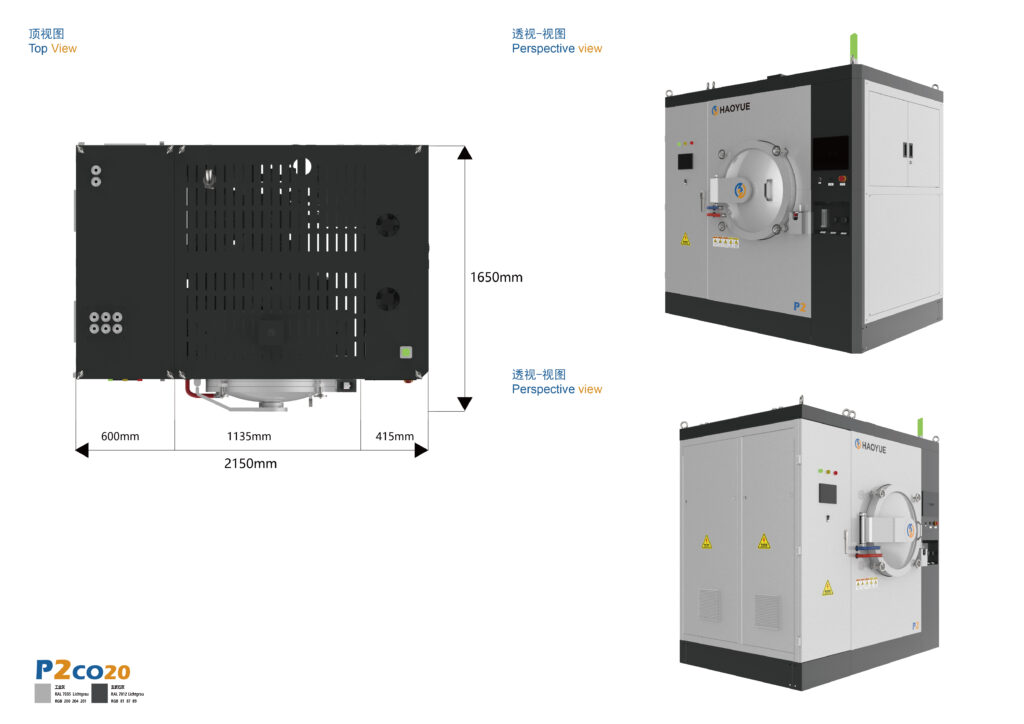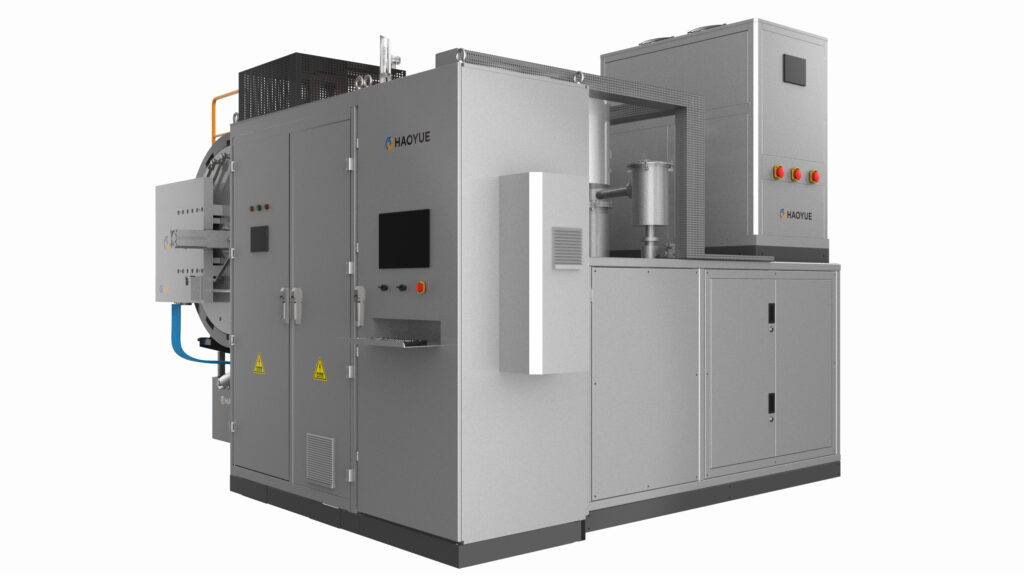






A gas pressure sintering furnace (GPS) is a batch vacuum furnace that sinters ceramic and cemented carbide parts under a positive pressure of nitrogen or argon — typically a few megapascals — so that densification can continue at temperatures where the material would otherwise decompose or stop shrinking. It is the densification route that gets complex-shaped silicon nitride and SiAlON components to near-full density without the uniaxial pressure of a die set, and without the gas-tight encapsulation that hot isostatic pressing normally requires.
That combination — pressure without geometry constraints, and pressure without encapsulation — is the reason process engineers keep searching for four de frittage sous pression de gaz specifications rather than jumping straight to HIP. The pressure is lower by an order of magnitude, and in exchange you get parts that come out of the furnace at final shape.
This article covers the five process stages inside the vessel, the parameters you should be asking a supplier to put in writing, and the specific cases where gas pressure sintering is the wrong specification.
What Is a Gas Pressure Sintering Furnace?
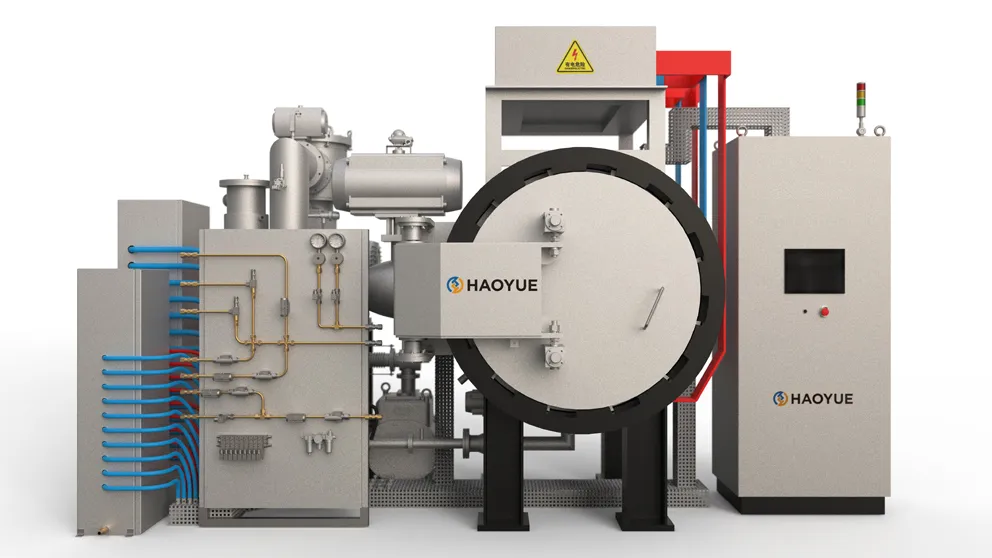
A gas pressure sintering furnace combines three systems in one vessel:
- A pressure vessel rated for an internal gas pressure in the 6 to 10 MPa class, which simultaneously acts as the vacuum chamber.
- A graphite hot zone that provides 1600 °C or 2000 °C capability, depending on model.
- A dual-mode atmosphere system that can evacuate the chamber to a rough-vacuum level and then backfill or pressurise with nitrogen or argon on a controlled ramp.
Three routes get confused with each other constantly, and the difference is mechanical, not semantic:
| Itinéraire | How pressure is applied | Nos spécifications | Encapsulation needed? |
|---|---|---|---|
| Frittage sous pression de gaz (série G) | Isostatic, via compressed gas | 6 or 10 MPa, 1600 / 2000 °C | Non |
| Hot pressing (P series) | Uniaxial, via a ram and die set | 100–1200 ton, 2200 °C | Not applicable |
| Pressage isostatique à chaud (série I) | Isostatic, via compressed gas | 100 / 150 / 200 MPa, 2000 °C or 1400 °C | Usually yes, for open porosity |
The practical consequence: GPS gives you isostatic pressure, which means no shape restriction from a die and no density gradient from die-wall friction — but at a pressure level one to two orders of magnitude below HIP. That is enough for the ceramic systems where the pressure is really being used to suppress a chemical reaction, not to crush out residual porosity indiscriminately.
When the pressure stage follows pore closure, the same configuration is often described as sinter-HIP, and in our G series it is used that way for SiC, ZrO₂, Al₂O₃, Si₃N₄ ceramics and cemented carbide.
How Gas Pressure Sintering Works — Stage by Stage
Stage 1 — Organic removal
Green parts carry binder, and the first job of the cycle is to get it out without cracking the part. Our G series integrates both positive-pressure dewaxing and vacuum dewaxing in the same vessel, which matters because different binder systems demand different removal regimes — a wax-based feedstock behaves differently from a PEG or PVA system, and a single fixed profile will fail on one of them.
Removal must be complete before the vessel is sealed and pressurised. Residual organics that decompose at high pressure leave carbon and gas inside the part, and that shows up later as porosity or as an off-specification microstructure that cannot be corrected downstream.
Stage 2 — Vacuum sintering
After debinding, the chamber evacuates and the part begins to densify. The vacuum configuration on our G series is 10 Pa, achieved with mechanical pumping — a rough/medium-vacuum level, not a diffusion-pump high-vacuum level. That is a deliberate configuration, not a limitation to hide: at this stage the vacuum exists to remove air, moisture and residual binder vapour, and to provide a clean environment while the pore network is still open to the chamber.
If your process requires the parts to see genuine high vacuum before consolidation begins, that is a different specification and you should raise it explicitly at enquiry stage.
Stage 3 — Partial-pressure sintering
This is the stage that most distinguishes GPS from pressureless sintering. For non-oxide ceramics such as silicon nitride, the material is thermodynamically unstable at the temperatures needed for full densification: at ambient pressure it decomposes rather than shrinks. Backfilling with nitrogen to a controlled sub-atmospheric or low-pressure level shifts the equilibrium back and lets the temperature go up.
Getting this stage right is a balance. Too little nitrogen and the surface degrades; too much, applied too early through an open pore structure, and the gas simply permeates the part without doing useful work.
Stage 4 — Pressure sintering
Once the pore network has closed, the chamber pressure is raised to its working level — 6 or 10 MPa on our G series — and held through the final densification soak. At this point the gas can no longer penetrate the part, so the pressure acts isostatically on the outer surface and drives the residual closed porosity to zero.
Because the pressure is applied through the outside surface rather than through tooling, complex geometries are not a problem: undercuts, internal channels, thick-to-thin transitions and parts that could never be ejected from a die all densify with the same pressure acting on every external surface.
Stage 5 — Controlled cooling and depressurisation
Depressurisation rate and cooling rate are usually underspecified at enquiry stage and then turn out to matter. A rapid drop in pressure, or an uncontrolled cool through a temperature range where the material is still reactive, can produce cracking in thick sections or surface degradation. Our G series provides controlled cooling as part of the cycle and an integrated atmosphere-control function across all five stages.
One further point worth making to anyone comparing offerings: our G series performs debinding and sintering in a single unit with the optional debinding system, so the part never leaves the controlled atmosphere between stages. That eliminates the re-oxidation and handling damage that a two-furnace route introduces.
Paramètres clés
| Paramètre | Spécification | Why it decides your outcome |
|---|---|---|
| Working gas pressure | 6 or 10 MPa | The level that closes porosity after pore closure |
| Température maximale | 1600 °C or 2000 °C (by model) | Governs which material systems are reachable |
| niveau de vide | 10 Pa (mechanical pumping) | Debinding and pre-sintering clean-up stage, not a high-vacuum claim |
| Matériaux de zone chaude | Graphite (GR) | Restricts the atmosphere to nitrogen or argon |
| Chamber options | 300 × 300 × 1000 mm up to 500 × 500 × 1800 mm (horizontal); Φ350 × 700 mm up to Φ500 × 1000 mm (vertical) | Part envelope and batch load |
| Chargement | Side-opening door (horizontal); bottom loading (vertical) | Handling and automation fit |
| Integrated functions | Positive-pressure dewaxing + vacuum dewaxing + vacuum sintering + partial-pressure sintering + pressure sintering + atmosphere control + cooling | Single-cycle debind-and-sinter |
| Contrôle | Fully automatic cycle control | Recipe repeatability; fewer operator-dependent variables |
| Déliantage | Optional integrated debinding system | Removes a separate process step and its oxidation risk |
Our Gas Pressure Sintering Furnace Models
Two geometries, sized to different part families:
| Modèle | Structure | Chambre (mm) | Zone chaude | Chargement | Pression du gaz | Aspirateur ultime | Température maximale |
|---|---|---|---|---|---|---|---|
| G3H | Horizontal | 300 × 300 × 1000 | GR (graphite) | Side door | 6 / 10 MPa | 10 Pa | 1600 / 2000 °C |
| G9H | Horizontal | 500 × 500 × 1800 | GR (graphite) | Side door | 6 / 10 MPa | 10 Pa | 1600 / 2000 °C |
| G3V | Verticale | Φ350 × 700 | GR (graphite) | chargement par le bas | 6 / 10 MPa | 10 Pa | 1600 / 2000 °C |
| G5V | Verticale | Φ500 × 1000 | GR (graphite) | chargement par le bas | 6 / 10 MPa | 10 Pa | 1600 / 2000 °C |
The horizontal chambers are the longer envelope, which suits elongated parts, racks and tooling loads. The vertical bottom-loading chambers suit batches of shorter, rotationally symmetric components — the geometry family that includes ceramic balls and rings.
Gas Pressure Sintering vs. Other Densification Routes
| Itinéraire | Pressure mode & level | Our temperature range | Choisissez-le quand | Évitez-le lorsque |
|---|---|---|---|---|
| Frittage sous pression de gaz (série G) | Isostatic gas, 6 / 10 MPa | 1600 / 2000 °C | Complex-shaped non-oxide ceramics in batch; silicon nitride balls and cutting tools; sinter-HIP treatment of SiC, ZrO₂, Al₂O₃ and cemented carbide | You need above 2000 °C, or open porosity that only very high pressure can close |
| Uniaxial hot pressing (P series) | Uniaxial, 100–1200 ton | 2200 °C | Simple discs, plates and blocks needing directional pressure at higher temperature | Complex geometry that cannot be ejected from a die |
| HIP (I series) | Gaz isostatique, 100 / 150 / 200 MPa | 2000 °C (zone chaude C/C) ou 1400 °C (molybdène) | Full densification of complex shapes from open porosity; casting consolidation; diffusion bonding | Budget or encapsulation economics rule it out |
| Frittage sous vide sans pression (série V) | Aucun | Up to 2400 °C (graphite hot zone) | Powder metallurgy, debind-and-sinter, parts where pressure adds nothing | La densité cible ne peut être atteinte sans application de pression. |
| Frittage par plasma étincelle (série S) | Uniaxial, pulsed-current heating | 2200 °C, up to 300 °C/min | Nanostructure retention and fast development cycles | Large parts, or low capital per kilogram is the priority |
Applications
Gas pressure sintering earns its place wherever full density has to be combined with a shape that tooling cannot deliver, and where the pressure’s real job is to keep the chemistry stable rather than to force powder together. In our own G series that means:
- Silicon nitride components — including ceramic balls and rings processed under high-pressure nitrogen or argon.
- outils de coupe en céramique, where a fully dense, fine-grained body is the difference between predictable tool life and unpredictable fracture.
- SiC, ZrO₂, Al₂O₃ and Si₃N₄ ceramics and cemented carbide given a sinter-HIP treatment.
- Research and pilot-scale batch production at institutes and universities, where the same vessel has to run development cycles and small production lots without a process change.
- Automotive turbocharger and high-temperature structural parts in the SiAlON and silicon nitride families, and batch cutting-tool production.
Limitations: When Not to Choose a Gas Pressure Sintering Furnace
- Process temperatures above 2000 °C. Our G series tops out at 2000 °C. That is a technology boundary, not a model choice — it is where our P-series hot presses operate, at the cost of uniaxial geometry constraints.
- Open porosity at the pressure stage. Isostatic gas cannot close porosity that is still connected to the surface. If a part must densify from fully open porosity, the route is HIP at 100–200 MPa, with the encapsulation that implies.
- Pressure-sensitive microstructures. 6 to 10 MPa is deliberately gentle, but it is still pressure. Materials whose microstructure or phase assemblage is pressure-sensitive need evaluating at your own parameters, not on a catalogue claim.
- Reducing or oxidising atmospheres. The graphite hot zone means the process atmosphere is nitrogen or argon. Hydrogen work belongs on a hydrogen furnace with a molybdenum hot zone, and oxidising atmospheres are excluded by the hot zone material itself.
- Die-defined near-net shape. If the geometry is defined by tooling and directional pressure is the mechanism that delivers density, that is hot pressing — GPS gives isostatic pressure and no die, which is exactly the point and also exactly the reason it cannot substitute.
- Very high vacuum as a process requirement. The vacuum stage in our G series is a 10 Pa mechanical-pump configuration used for debinding and clean-up. If your process logic depends on genuine high vacuum before consolidation, specify it as a separate requirement so it can be assessed honestly.
- Part dimensions beyond the chamber. Envelopes run from 300 × 300 × 1000 mm (G3H) to 500 × 500 × 1800 mm (G9H) horizontally, and Φ350 × 700 mm to Φ500 × 1000 mm vertically. Parts outside those envelopes need a different conversation, not a bigger batch.
FAQ
What is a gas pressure sintering furnace used for?
It sinters ceramics and cemented carbides under a few megapascals of nitrogen or argon, so full density is reached at temperatures where the material would otherwise decompose. Typical work in our range includes silicon nitride balls and rings, ceramic cutting tools, SiC, ZrO₂ and Al₂O₃ components, cemented carbide, and batch production of high-temperature structural parts.
What pressure and temperature does a gas pressure sintering furnace run at?
Our G series operates at 6 or 10 MPa working gas pressure and 1600 °C or 2000 °C, depending on model, with a 10 Pa vacuum stage for debinding and pre-sintering clean-up. Pressure and temperature are stage variables within one automatic cycle, not fixed set points.
Is gas pressure sintering the same as HIP?
No. Both apply isostatic gas pressure, but at very different levels: GPS works in the 6–10 MPa class, while hot isostatic pressing in our I series runs at 100, 150 or 200 MPa. The practical difference is encapsulation — GPS typically does not need it, because the pressure stage follows pore closure, whereas HIP often does when starting from open porosity.
Why does silicon nitride need nitrogen pressure to sinter?
At the temperatures required for full densification, silicon nitride is thermodynamically unstable at ambient pressure and decomposes rather than shrinking. Backfilling with nitrogen to a controlled pressure shifts the equilibrium and allows the temperature to rise far enough for liquid-phase densification to complete, which is why the partial-pressure stage exists inside the cycle.
Does GPS need encapsulation or a gas-tight can?
Normally not within the GPS envelope. Because the pressure stage is applied after the pore network has closed, the gas cannot penetrate the part and encapsulation is unnecessary. This is the main economic argument for GPS over HIP for geometries that already meet the density target within the 6–10 MPa envelope.
When should I not use gas pressure sintering?
When the process exceeds 2000 °C, when the part must densify from open porosity and needs 100 MPa or more, when the microstructure is pressure-sensitive, when the atmosphere must be hydrogen or oxidising, or when density depends on directional pressure from a die set. In those cases hot pressing, HIP, or a hydrogen furnace is the correct specification.
If you have a green part, a binder system and a target density, send us the drawing and the material specification. We will run a debind-and-sinter cycle on our own G-series equipment and return the density, microstructure and process data before you commit to a specification.
Équipements associés : Four de frittage sous pression de gaz série G · Four de pressage à chaud sous vide en graphite série P · MIM Debinding Sintering Furnace